Recipes

How to make Homemade Pretzels
Last updated April 5, 2026.
Makes 12-14 pretzels
Ingredients
250 ml water
7 g yeast
20 g sugar
30 ml EVOO
412 g AP flour
3 g sea salt
50 g lye
1000 ml filtered water
Directions
Whisk together the water, yeast, and sugar. Cover with plastic wrap and let sit for 5 minutes. Whisk in oil.
In a separate bowl, whisk together the flour and salt.
Add the wet ingredients to the dry and knead by hand until smooth. Transfer to a large greased bowl and cover with greased plastic wrap. Let double in size (~1.5 hours)
Heat the oven to 450˚F.
Punch down the dough to release the gas, and turn out onto an unfloured surface. Divide into 12 to 14 pieces, about 65 g each, and roll each piece into a ball. Place them on a baking sheet, cover them with a towel or paper towel, and rest for ten minutes, covered. Roll each ball into long rods, 13-14 inches long. Shape into pretzel.
Prepare the lye bath by carefully stirring together the lye and water.
Dip each preztel in the lye bath for 15 seconds. Transfer to Silpat-lined baking sheet. Sprinkle with salt, bake for 10-15 minutes. Brush with butter.

Chili
A bowl of chili
Last updated: October 11, 2026
Servings: 8
Cooking Time: 2–3 hours
Ingredients
Meat & Vegetables
450 g (1 lb) ground beef
450 g (1 lb) Italian sausage
30 g (2 tbsp) olive or canola oil
30 g (2 tbsp) butter
500 g (2–3 cups) yellow onions, diced (½ inch)
1 red bell pepper (200–250 g), diced (½ inch)
1 green bell pepper (200–250 g), diced (½ inch)
2 jalapeños (50 g), seeded and finely diced
5 cloves garlic (20 g), minced
Spices & Other Ingredients
3 tbsp tomato paste
5 g ground cumin
10 g chili seasoning
10 g smoked paprika
2 g cayenne pepper (optional)
2.5 g dried oregano
½ bottle red wine (about 1½ cups). A full bottle is even better.
2 cans (28 oz each) whole peeled tomatoes
Kosher salt, to taste
Optional Toppings
Chopped green onions
Grated sharp cheddar cheese
Sour cream
Fritos
Directions
1. Brown the beef
450 g (1 lb) ground beef
Heat a large, heavy-bottomed pot over high heat. Add the ground beef and cook until browned. Transfer to a bowl and set aside.
2. Brown the sausage
450 g (1 lb) Italian sausage
Add the sausage to the same pot and cook until browned. Transfer to the bowl with the beef.
3. Sauté the vegetables
30 g (2 tbsp) olive or canola oil
30 g (2 tbsp) butter
500 g (2–3 cups) yellow onions, diced
1 red bell pepper (200–250 g), diced
1 green bell pepper (200–250 g), diced
2 jalapeños (50 g), seeded and finely diced
Add the oil and butter to the pot. Once the butter has melted, add the onions, bell peppers, and jalapeños. Sauté until softened and beginning to brown.
4. Add the garlic
5 cloves garlic (20 g), minced
Stir in the garlic and cook until fragrant, about 1 minute.
5. Cook the tomato paste
3 tbsp tomato paste
Make some room in the pot and add the tomato paste. Cook until it darkens slightly, then stir everything together.
6. Add the spices, wine, and tomatoes
5 g ground cumin
10 g chili seasoning
10 g smoked paprika
2 g cayenne pepper (optional)
2.5 g dried oregano
½ bottle red wine (about 1½ cups)
2 cans (28 oz each) whole peeled tomatoes
Return the browned meat to the pot. Add the spices, red wine, and tomatoes. Stir to combine, breaking up the tomatoes with your spoon.
Note: I often use a full bottle of wine, and it's really, really good.
7. Simmer
Bring the chili to a simmer, then reduce the heat to low. Cook gently for 2–3 hours, stirring occasionally, until the chili thickens to your desired consistency.
8. Season and serve
Kosher salt, to taste
Your favorite toppings
Taste and adjust the salt as needed. Ladle into bowls and finish with your favorite toppings.

Pasta Carbonara
Last updated: June 1, 2026.
Serves 4-6
Ingredients
200g guanciale, 1/2-inch-dice
30g Pecorino Romano, finely grated
20g Parmagiano-Reggiano, finely grated
2g freshly grated Tellicherry black pepper
64 g (4) egg yolks
3L water
45 g kosher salt
450g fresh pasta or 250g dried spaghetti
Directions
Add guanciale to a cold 12-inch frying pan and heat over medium heat. As the fat renders, toss or stir the guanciale. You want it crispy on all sides but not burned. If the fat starts to smoke, lower the heat.
Place a mesh strainer over a bowl or measuring cup and strain the guanciale, reserving both. Let them cool to room temperature.
Add egg yolks and pepper to a bowl that’s large enough to fit over your pasta pot and large enough to hold all the pasta.
Add water and salt to a pot and cook pasta according to package directions until it’s just shy of al dente. Transfer to the bowl with the yolks in it and add 8oz or 250ml of pasta water and two spoonfuls of the reserved guanciale fat.
Set the bowl over the pasta pot, and reduce heat to low. We’re going to treat this as a gentle double boiler to help tighten up the sauce. Stir until sauce thickens slightly. Add the guanciale and stir to combine.
Divide among 4-6 bowls, topping with cheese and a few more turns of pepper.

Romesco
h/t to chefsteps for this recipe. I omitted the parm for because I wanted to highlight the other flavors, and I was NOT disappointed. Original recipe here.
Makes ~2 cups
Ingredients
120 g (1 cup) hazelnuts
150 g (1 cup) roasted red peppers
90 g (1/4 cup) olive oil
20 g (1.5 T) apple cider vinegar
15 g (3 large cloves) garlic
10 g (1 cup, not packed) parsley
8 g (1.5 T) Diamond Crystal kosher salt
10 g (2 T) Smoked paprika
Recipe
Toast the nuts in a large frying pan over medium heat until fragrant. Add everything to a blender. Blend!

Rigatoni all’Arrabbiata
This post contains affiliate links. As an Amazon Associate I earn from qualifying purchases—if you buy through them, it costs you nothing extra and helps keep this site running.
Last Updated: July 12, 2026
Serves 4-6
Ingredients
3 liters (3 quarts) water
45 g (a handful) kosher salt
20 g (2 T) EVOO
20 g (6 cloves) garlic, thinly sliced
2 g (1 T) crushed red pepper
800 g (28 ounce can) San Marzano tomatoes
400 g (~1 lb) dried rigatoni
Recipe
Bring the water and salt to a boil in a pot large enough to fit the pasta.
Meanwhile, heat the EVOO over medium heat in a Dutch oven (👈🏾 affiliate link) or a pan large enough to mix everything together. Once warm, add the garlic and sweat until softened, about 7 minutes, adjusting the heat as necessary to not brown the garlic. Add crushed red pepper, stir, and cook until fragrant, 2-3 minutes. Add the tomatoes, breaking them up a bit with your spatula, and cook for 10 minutes to thicken slightly.
Cook the pasta in the water according to package directions. Two to three minutes before the pasta is done, transfer it to the sauce using a spider (👈🏾 affiliate link). Reserve a cup of the pasta water and add that to the sauce. Increase heat to medium-high and cook until thickened, about 2-3 minutes.

Butternut Squash Risotto

A bowl of butternut squash risotto
Missed me cooking this on Pots & Pandemics? Click here to watch.
Serves 6
Ingredients
1300 g, 6 cups vegetable/chicken/turkey broth
100 g, 7.5 tbsp EVOO
50 g (2 small) shallots, 1/4-inch-dice
5-7 g Diamond Crystal kosher salt
600 g, a little over 3 cups diced butternut squash, peeled 1/2-inch-dice
200 g, 1 cup carnaroli risotto rice
A bunch of sage leaves
60 g, 4 tbsp butter
60 g, 1 cup grated Parmiggiano-Reggiano cheese
Recipe
1300 g, 6 cups vegetable/chicken/turkey broth
Bring broth to a simmer in a medium saucepan.
100 g, 7.5 tbsp EVOO
50 g (2 small) shallots, 1/4-inch-dice
600 g, a little over 3 cups diced butternut squash, peeled 1/2-inch-dice
3-5 g Diamond Crystal kosher salt
Add oil to a dutch oven over medium heat. Reduce to medium-low and sweat the shallots until translucent. Add butternut squash, the salt, and about 1 cup of the stock. Cover and cook for 10 minutes.
200 g, 1 cup carnaroli risotto rice
A bunch of sage leaves
Salt, as needed
Add the rice and sage leaves. Increase heat to high and add 1 cup of stock. Stir continuously until almost all of the stock has evaporated or been absorbed. Repeat until the rice is al dente. (Test it. It should still have a little chew to it.) Season with additional kosher salt, as needed.
60 g, 4 tbsp butter
60 g, 1 cup grated Parmiggiano-Reggiano cheese
When the rice is al dente, turn off heat, and add cheese and butter. Stir like crazy to emulsify everything.

A bowl of butternut squash risotto

Sous Vide Beet Risotto
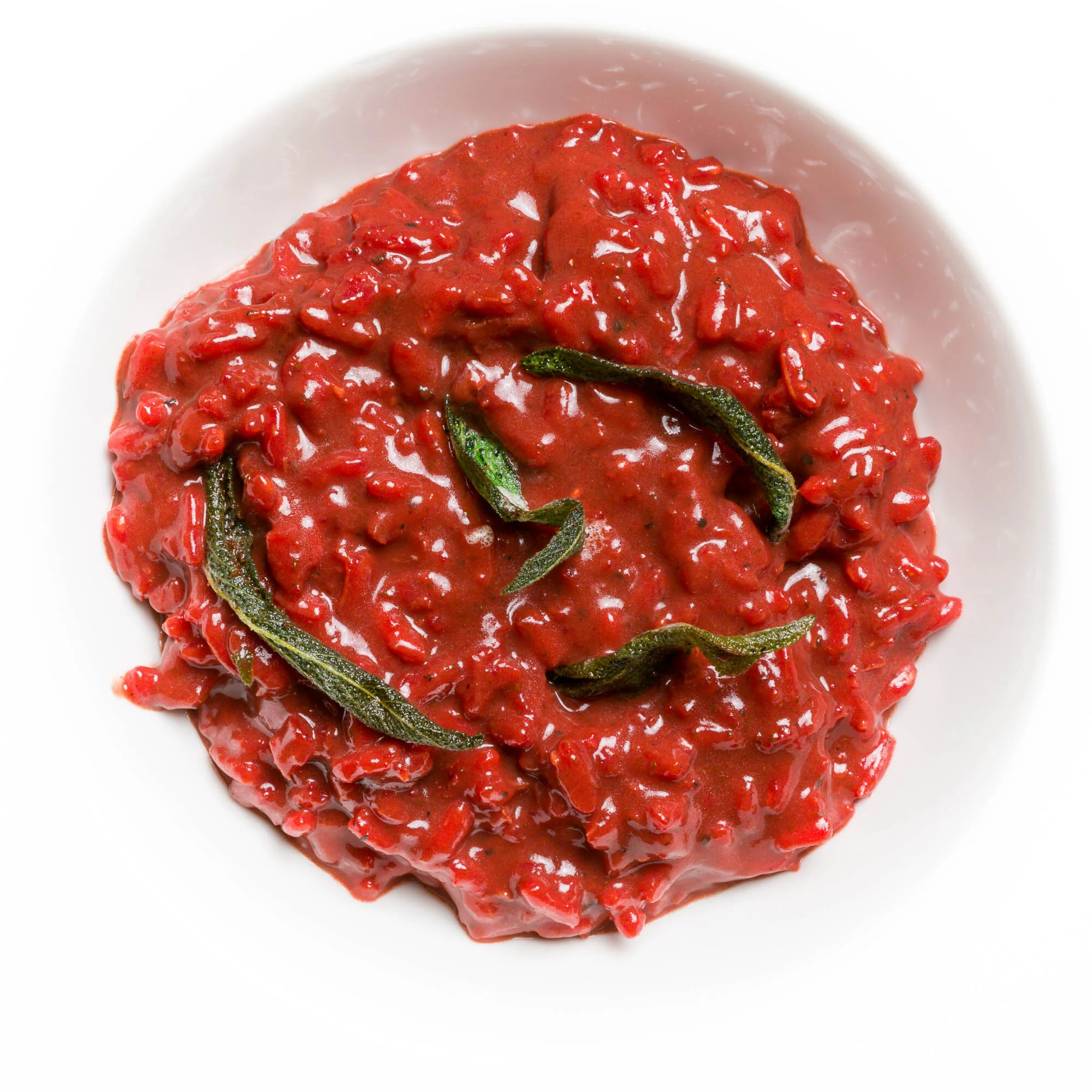
Inspired by Chefsteps.com's sous vide risotto recipe.
Serves 2
Ingredients
100 g butter, divided (see below)
A bunch of sage leaves
6 garlic cloves, lightly smooshed but with skin left on
100 g carnaroli rice
30 g Parmigiano-Reggiano, grated
5 g kosher salt
.5 g peppercorn, finely ground
200 g beet juice
100 g foul broth (I used turkey, but chicken would be great here too)
1 egg yolk
Recipe
40 g butter
A bunch of sage leaves
6 garlic cloves, lightly smooshed but with skin left on
Melt butter in a small skillet over medium heat. Add garlic and sage leaves and fry until the sage leaves are crispy, about 10 minutes. Adjust heat if the garlic starts to burn, or just remove it with large tweezers, tongs, or a spoon. Transfer the sage leaves to a paper-towel-lined plate. Strain the brown butter with a fine mesh strainer. Discard (or eat!) the garlic and skins. Reserve the browned butter bits for this recipe. Reserve the clarified browned butter for another use.
100 g carnaroli rice
30 g Parmigiano-Reggiano, grated
5 g kosher salt
.5 g peppercorn, finely ground
200 g beet juice
100 g foul broth (I used turkey, but chicken would be great here too)
Heat a water bath to 98˚C (208˚F). Add ingredients to a gallon-sized Ziploc freezer bag. Remove as much air as possible and seal. Add to the water bath and cook for 15 minutes. Remove, mix, and return to the water bath for another 15 minutes. You don't have to open the bag to mix. You can just roll it around on the counter top, or lightly fluff the bag with your hands.
60 g butter
1 egg yolk
Reserved brown butter bits
Add to a large mixing bowl. Add the contents from the bag and beat with a wooden spoon. You're trying to emulsify the cheese, butter, and egg yolk to create a creamy, smooth consistency. Divide among two bowls and serve. Top each of the bowls with some of the reserved fried sage leaves.


Brown butter pappardelle, sage, ricotta salata

A bowl of brown butter pappardelle with sage and ricotta salata.
Serves 4
Ingredients
3 L water
45 g kosher salt
60 g (4 T) butter. I used salted, but it doesn't really matter
30 g sage leaves
450 g (1 lb) fresh pasta. I used pappardelle in the image above, but any long noodle would be fine here.
60 g ricotta salata cheese, finely grated
Finishing salt, to taste
Recipe
3 L water
45 g kosher salt
Add the water and kosher salt to a pot large enough to cook pasta, and bring to a boil.
60 g butter
30 g sage leaves
Add the butter to a large dutch oven and melt over medium heat. Add the sage leaves. Fry until the butter is about 3 minutes away from being fully brown. It should smell nutty and sagey and be a medium to medium-dark brown color. Carefully remove a dozen of the largest sage leaves and reserve. I use long tweezers to do this.
450 g (1 lb) fresh pappardelle
Add the pasta to the boiling water and cook for 3 minutes.
60 g ricotta salata cheese, finely grated
Finishing salt, to taste
600mL (2.5 cups) pasta water
Transfer the pasta to the butter-sage sauce. Add the cheese. Add the pasta water to the pasta, increase heat to high, and cook, stirring constantly, for 3-5 minutes. The goal here is to emulsify the water and butter. The cheese will not melt, but that's expected.
Divide among four bowls and serve. Top each of the bowls with 3 fried sage leaves.
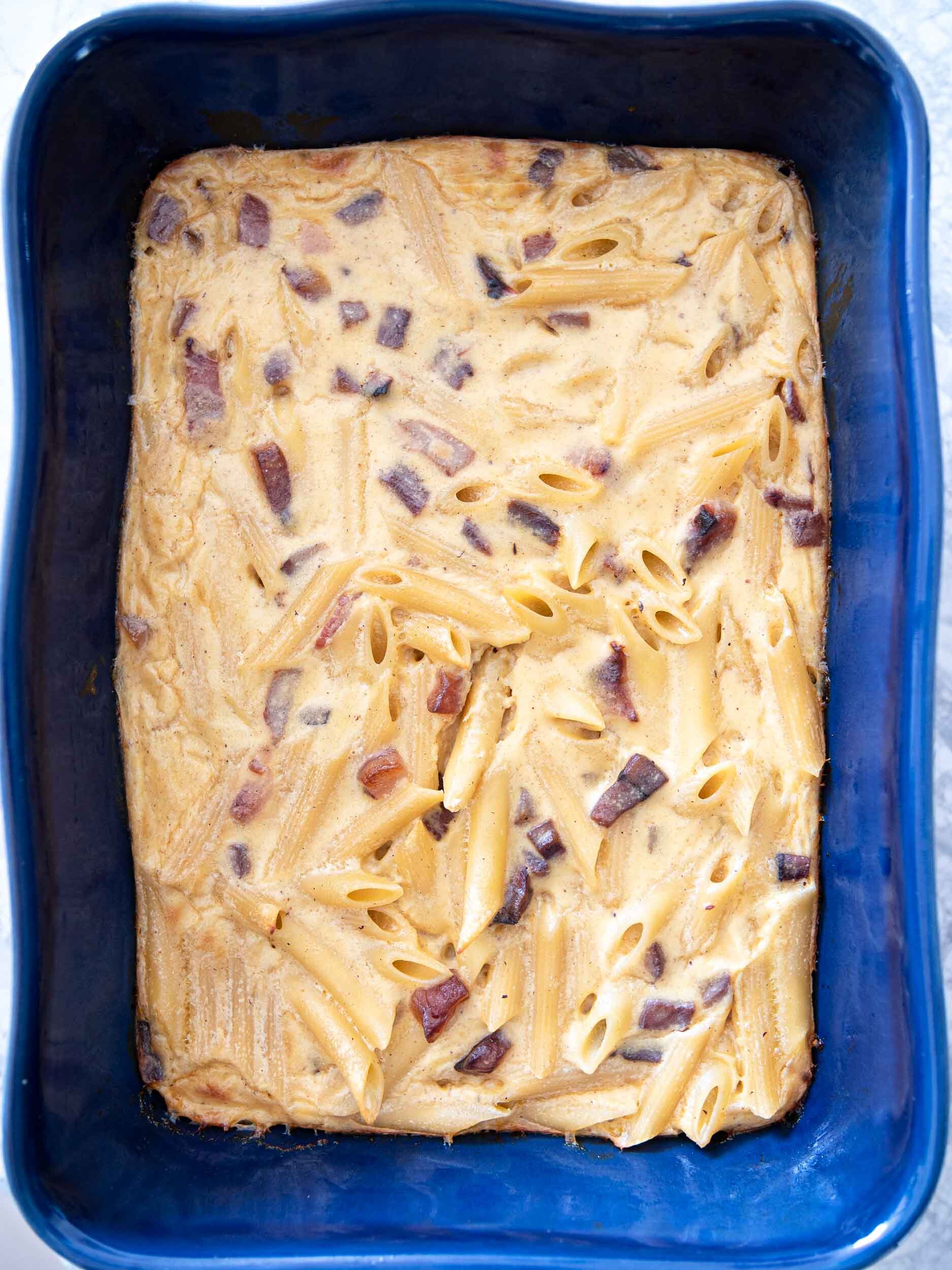
"Bacon & Eggs" Noodle Kugel

Note: this recipe was part of a book I wrote called Eat Like A Maisel.
When I was a kid, I took casseroles for granted. I didn’t understand the complex mathematical formula of nutrition, bulk, and ease that a casserole affords to a parent.
You mean, I can combine everything in one pan, throw it in the oven, and when I pull it out, I’ll have a happy and full family? Done and DONE!
The downside with casseroles is they tend to lack texture. They fall into that slow-cooker style of texture-less mush.
But they don’t have to!
This is one of those dishes where no matter how much extra you THINK you have, you’ll find a way to demolish the entire thing faster than your elastic waistband can expand.
If you happen to succeed in saving leftovers, it’s perfect for breakfast the next day. I like to perform a magic trick in the morning: I cut a giant square, nuke it for 30 seconds, and surprise everyone with how quickly I eat it.
I get why moms were so into casseroles. They’re easy, tasty, and 100 percent healthy. (Don’t fact-check that.)
Guanciale is cured pork cheeks (the front ones). If you can’t find it, use pancetta. If you can’t find pancetta, use bacon. If you can’t find bacon, you probably aren’t living on Earth, in which case, you should come visit sometime! Bacon’s the best thing we’ve got!
1⁄2 pound guanciale, cut into lardons, 1⁄4 inch by 1⁄4 inch by 1 inch
7 tablespoons (100 g) butter
1 tablespoon (10 g) flour
4 cups (1000 g) milk
8 egg yolks
41⁄2 ounces (125 g) Parmigiano-Reggiano cheese, freshly grated
2 teaspoons (6 g grated) nutmeg
1 pound (453 g) penne pasta
Heat oven to 350 ̊F.
Add guanciale to a cold skillet large enough to fit it all on one layer. Turn heat to high. Turn heat to low as soon as you hear the sizzle. Cook until one side is browned, then flip each lardon and brown the other side. Once done, transfer guanciale to a paper towel–lined plate.
Make the roux. Melt butter in a small saucepan over medium heat. Add flour to the saucepan, increase heat to medium-high, and stir constantly. You want it hot enough to cook out some of the flour flavor but not so hot that it starts browning. Reduce the heat if it starts browning. Add milk and bring to a simmer while stirring. Simmer for a minute and then remove from heat. Set aside. Let cool for 5 to 10 minutes so it doesn’t cook the egg mixture.
Beat egg yolks to combine in a bowl. Add cheese, nutmeg, and roux. Stir to combine. Set aside.
Bring a small pot of salted water (remember, it should taste like the sea) to a rolling boil. Cook the pasta for 4 minutes. Strain and discard the cooking water.
Transfer pasta to a 8 by 8–inch casserole dish. Add the guanciale and then the custard mix. Bake 30 to 45 minutes at 350 ̊F.

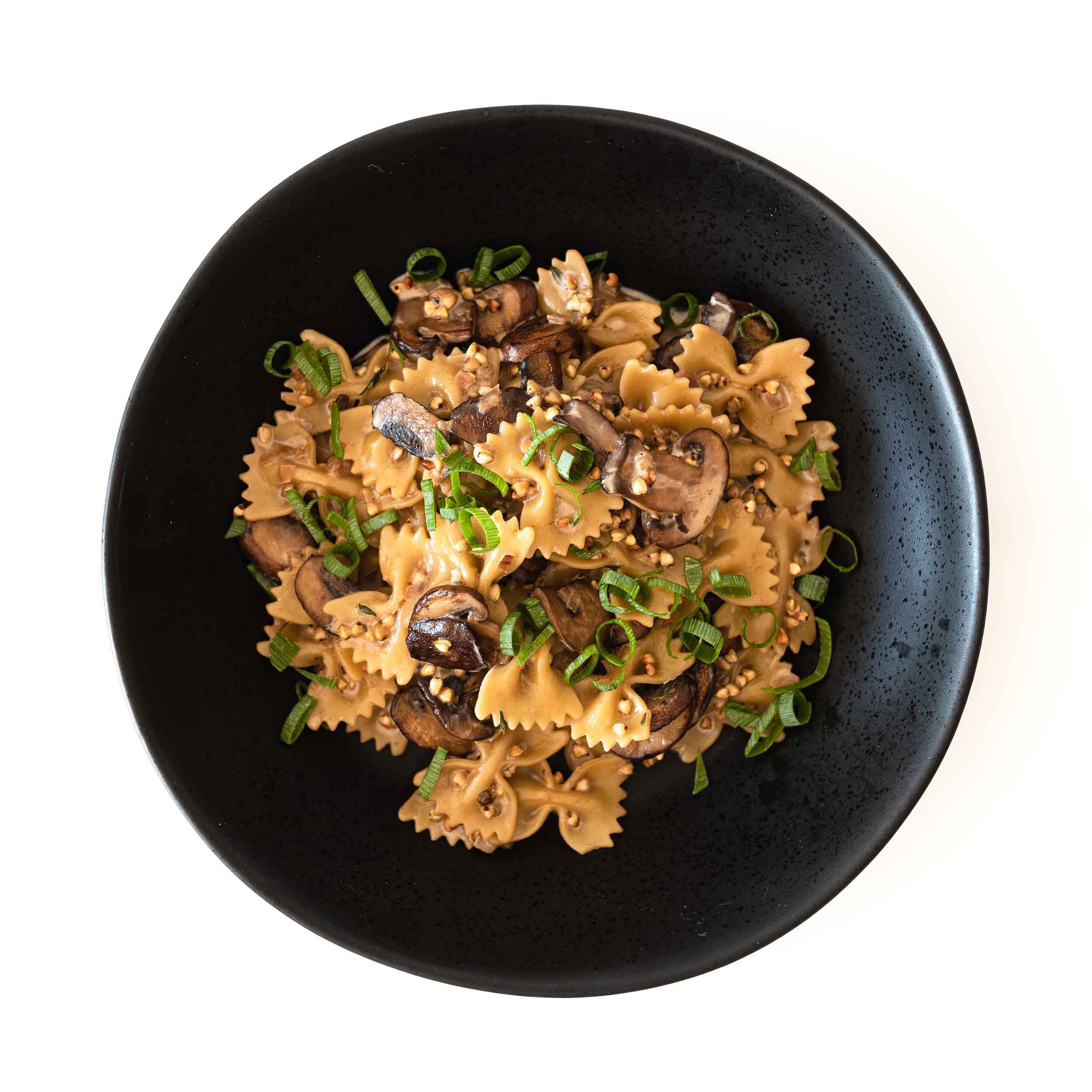
Kasha Varnishkes

This post contains affiliate links. As an Amazon Associate I earn from qualifying purchases—if you buy through them, it costs you nothing extra and helps keep this site running.
Updated: July 12, 2026
Note: this recipe was part of a book I wrote called Eat Like A Maisel.
Yield: 2 servings
“Half pastrami on rye, half chopped liver on hallah, stuffed cabbage, some kasha varnishkes, and a bit of arugula. Extremely Jewish and extremely hungry. The pickle’s funny.”—Herb Smith.
“DOINK.”—Herb Smith
“Don’t trust a guy who will work for salami.”—Susie Myerson
This is not your Bubbe’s Kasha Varnishkes. This is my Kasha Varnishkes, my take on the classic comfort dish. Same old kasha. Same old varnishkes. With a twist!
I couldn’t bring myself to include just another KV recipe in this book. You can search all over the internet for standard KV. You’ll find some variation of: kasha, bow-tie pasta, onions, egg, schmaltz.
If Herb Smith ordered KV and got this, he’d probably wonder when the owners of the Stage Deli sold to gentiles.
I’m gonna come right out and say it: I don’t get kasha. I’m sure it’s a favorite for some people. Or they grew up with their Bubbe making it for Yom Kippur. I tried it the conventional way and I just couldn’t get behind it. So, I changed it. It still has kasha. It still has varnishkes. It still has schmaltz. But it also has some other stuff.
Ingredients
1⁄4 cup (50 g) kasha
4 tablespoons (50 g) rendered chicken fat or olive oil
1⁄4 pound (40 g before prepping) shallots,
1⁄4-inch dice
1⁄2 pound (225 g) mushrooms
1⁄2 cup whole milk
1⁄4 cup (75 g) heavy cream
4 tablespoons fresh thyme
Water, as needed
Kosher salt, as needed
2 cups (100 g) bow-tie pasta
Directions
Add the kasha to a sauté pan set over medium heat until toasted. Give them a gentle shake every minute or two to toast evenly. It’ll smell nutty. Nutty is good. Transfer the toasted kasha to a small bowl. Set aside.
Add the oil to a large skillet set over medium heat. Add the shallots to the pan. If they start browning, reduce the heat to medium-low.
Add the mushrooms to the pan, toss or stir to combine, and increase the heat to medium-high. Sauté until the mushrooms are browned.
Add the milk, heavy cream, and fresh thyme to the pan, reduce heat to medium, and reduce the liquid by half.
FOR THE PASTA
Fill a large saucepan halfway with water. Add salt as needed. I’m a nerd and weigh my water and salt, adding 1% of the water’s weight in salt. So if I add 3 liters of water, which is 3 kg (3000 grams), I’ll add 30 grams of kosher salt. Please salt your pasta water. It’ll make this dish taste so much better.
Cook the pasta 1 minute less than the package directions.
TO COMPLETE
Use a spider (👈🏿 affiliate link) to transfer the pasta to the pan with the mushrooms. It’s okay if some of the pasta water comes with it. It’ll help season the mushrooms.
Add 1⁄4 cup of the pasta water to the pan and simmer for 2 to 3 minutes. Divide among two plates. Garnish with fresh chives and/or more fresh thyme.

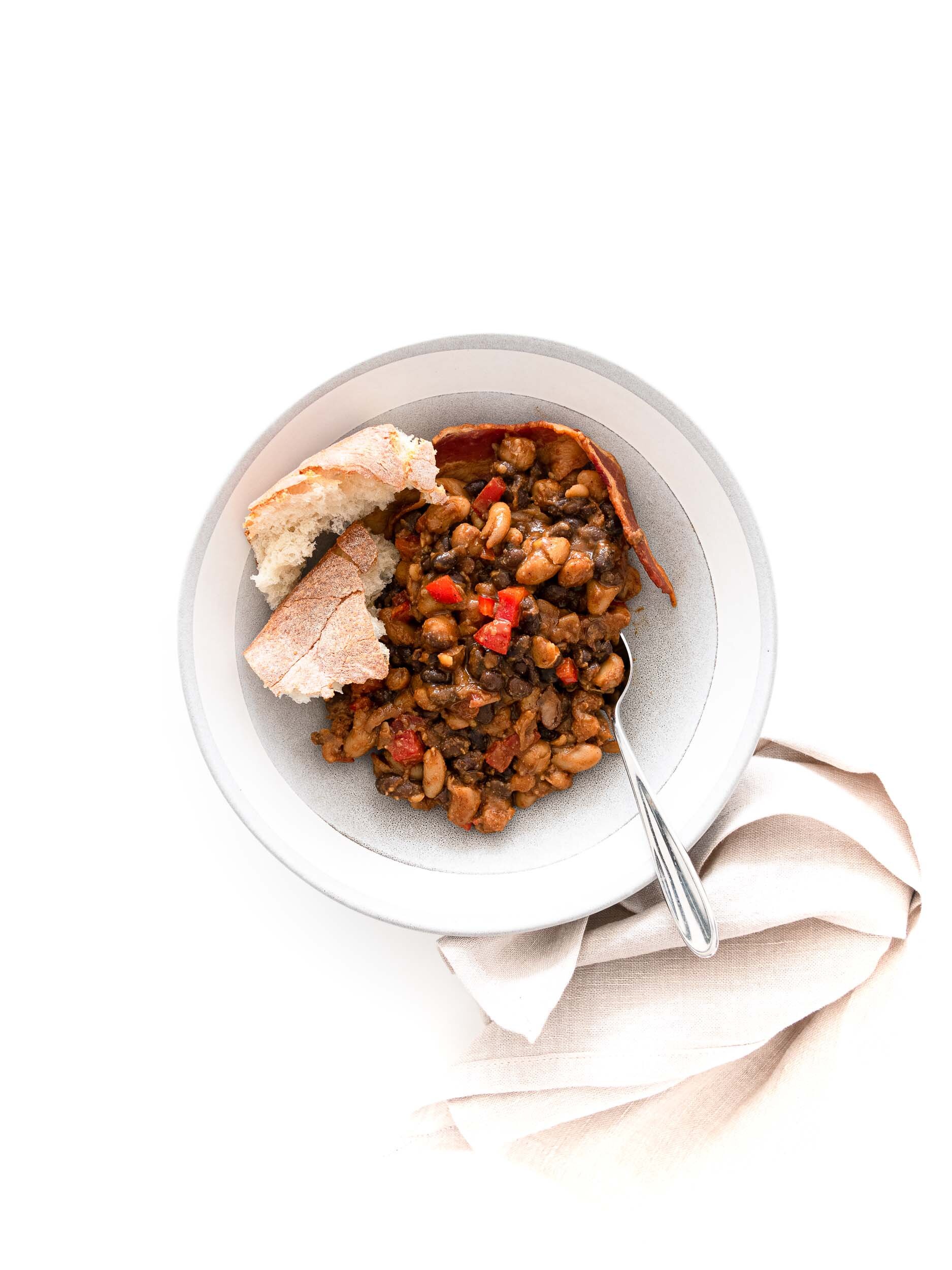
Susie's Beans

Note: this recipe was part of a book I wrote called Eat Like A Maisel.
Yield: 4–6 servings
I love Susie’s practicality. She eats a can of beans right out of the pan she warmed them in. But she deserves better. This dish pays homage to the original recipe (open can, eat) but introduces some variety in the beans and some interest in the flavors. The ingredient list is long, but you’ve probably got everything except the bell peppers on hand already.
I use Better Than Bouillon and water here instead of chicken stock to keep this simpler, more Susie-ish. I use so much chicken stock at home, I find it’s easier to keep a small jar of Better Than Bouillon in the fridge than jars and jars of chick stock.
7 ounces (200 g) bacon
1 (16-oz) can black beans, rinsed
1 (16-oz) can garbanzos, rinsed
1 (16-oz) can cannellini beans, rinsed
3 cups (750 ml or 750 g) water
1 tablespoon Better Than Bouillon, chicken flavor
1 teaspoon (1.5 g) cumin
2 teaspoons (3 g) chili powder
2 teaspoons (3 g) smoked paprika
1 teaspoon (1.5 g) cayenne, optional if you want a kick
1 teaspoon (1.5 g) dried oregano
1 1⁄2 cups (200 g) red bell pepper, 1⁄4-inch dice
1 1⁄2 cups (200 g) green bell pepper, 1⁄4-inch dice
crème fraîche, optional
Cheddar cheese, optional
Fritos, optional
Green onion, optional, sliced
Cook the bacon. Place bacon slices on a cooling rack placed on an aluminum foil–lined baking sheet. Put into a cold oven. Set to 400 ̊F and cook until crispy, 20 to 25 minutes.
Add all ingredients except the bell pepper and bacon to a large pot and cook over medium heat until simmering. Reduce heat to low and cook until liquid reduces to the texture of chili, about an hour. Add the diced bell pepper at the end and stir to combine.
Divide among serving bowls and top with crème fraîche, grated cheddar cheese, Fritos, and/or sliced green onion. Or eat them straight out of the pan, like Susie does.

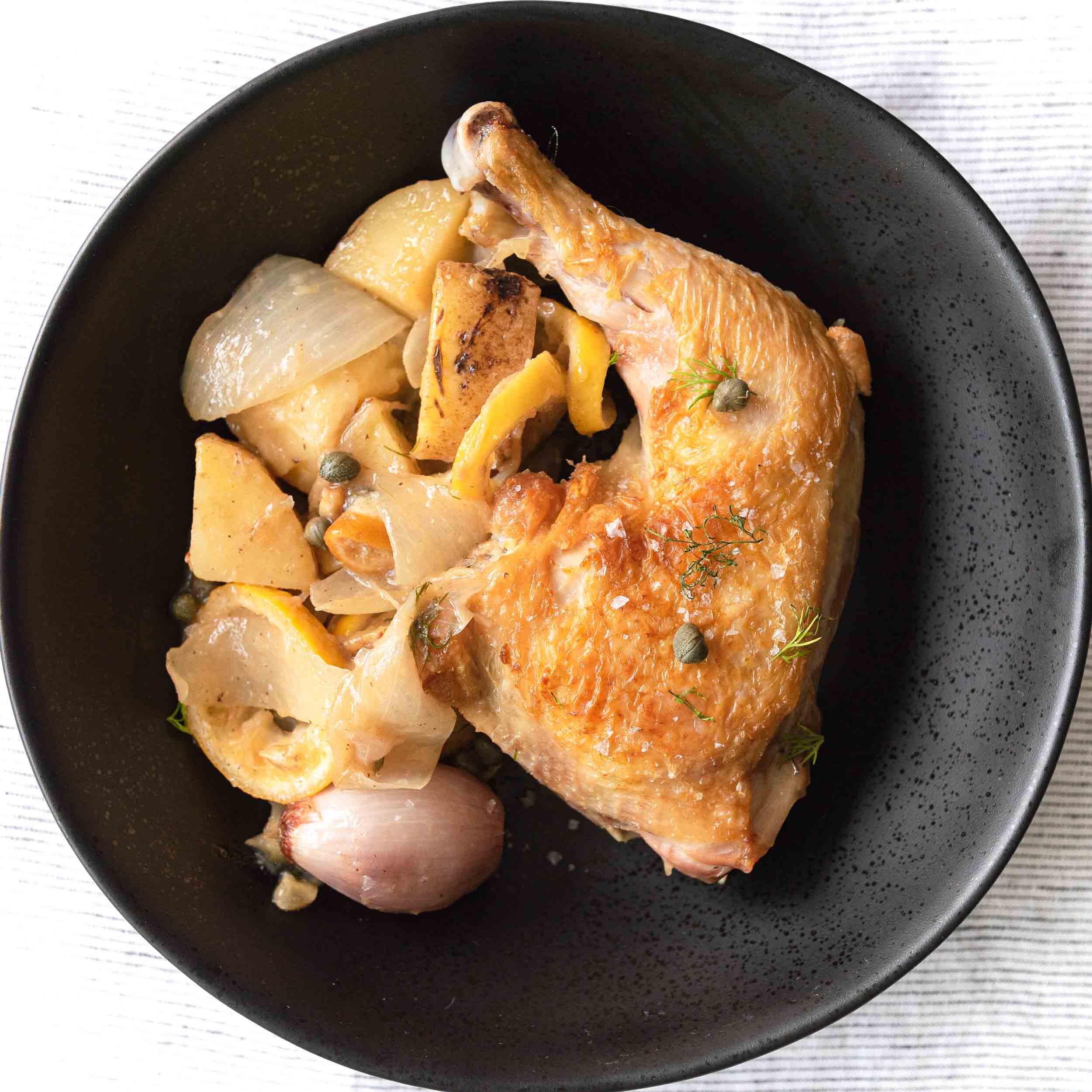
Braised Chicken Thighs

Note: this recipe was part of a book I wrote called Eat Like A Maisel.
Zelda deserves a few nights off, for all she does for the Weissmans.
4 chicken thigh and leg quarters (4 thighs and 4 legs)
Kosher salt, as needed
4 tablespoons (50 g) canola oil
8 cloves garlic (6 g)
1 pound (453 g) potatoes, 1⁄2-inch dice
2 onions, cut into wedges
1⁄2 pound (225 g) shallots
1 lemon, 1/8-inch slices, plus 1 lemon, halved, for lemon juice garnish
4 tablespoons (30 g) capers
4 tablespoons (30 g) green olives, diced
4 tablespoons (10 g) dill
4 tablespoons (10 g) parsley, for garnish
Preheat the oven to 350 ̊F.
Pat the chicken dry with paper towels. Season with kosher salt.
Add oil to a heavy-bottomed Dutch oven and heat over medium heat. Add chicken skin-side down and cook for 8 minutes. Remove the chicken to a cooling rack on a foil-lined baking sheet.
Smoosh (technical term) garlic under the broad side of a chef’s knife. Leave the skin on and add to the pan. Cook until the garlic is lightly browned, tilting the pan to cook the garlic in pooled oil. Once the garlic is browned, remove and discard.
Add the potatoes, onions, shallots, and lemon wheels to the pan. Place chicken on top of the vegetables and move the pan to the oven. Cook, uncovered, for 45 minutes, or until chicken is cooked through. You can use an instant-read thermometer to test for doneness (155 ̊F). Chicken legs are pretty forgiving to overcooking, so I tend to just go by time.
To complete, divide the potatoes and onions among 4 plates and place the chicken on top. Top with capers, olives, dill, a squeeze of lemon, and parsley.

Crème Fraîche Cheesecake

Last updated: February 18, 2026
Note: this recipe was part of a book I wrote called Eat Like A Maisel.
Yield: 2–4 servings
Why does everything have to be so sweet all the time? America loves sugar. Ohhh boy, do we love sugar. Our Cromag brains go bonkers when we taste sugar.
I’m done with all the sweet. I want bitter. And salty. Maybe a little sour in there for good measure.
Enter the Crème Fraîche Cheesecake. This is a dessert for people who don’t like things too sweet. It looks sweet. Sounds sweet. But it’s not too sweet. A lot like Midge. She looks like a nice, normal 1950s housewife but when she gets on stage, there’s a whole other side of her.
Ingredients
For the Cheesecake
4 ounces (114 g) cream cheese
1⁄4 cup (100 g) crème fraîche
11⁄2 tablespoons (40 g) sugar
1⁄4 cup (60 g) heavy cream
1⁄2 vanilla bean
1 egg
For the Graham Cracker Topping:
8 (60 g) graham crackers
1⁄2 cup (60 g) pistachios
1 stick (113 g) butter
Salt, to taste
Directions
For the cheesecake
Use an electric hand mixer to beat the cream cheese and crème fraîche in a large bowl until smooth. Add the sugar and cream and beat to mix until smooth again. Use a paring knife to cut a vanilla bean in half and reserve the other half for another use. Slice down the vanilla bean half to open the bean and expose the seeds inside. Take care not to cut all the way through the vanilla bean. Open the pod by folding the sides back and slide the knife down the length of the bean to scrape out all the seeds. Add them to the bowl along with the egg and beat to combine.
Preheat the oven to 325 ̊F. Put the mix in a 4-inch by 13⁄4-inch springform pan, place it on a parchment paper–lined baking sheet, and put it in the oven. Bake until the cake is set, about 25 to 30 minutes. It should still wobble a bit in the center.
For the topping
Add graham crackers and pistachios to a food processor fitted with the blade attachment. Process until it’s a fine meal.
Add butter to a small skillet over medium heat. It’ll melt, then bubble, then bubble smaller bubbles. When it smells nutty, remove from heat and pour into the graham cracker mixture.
Stir. It’ll look like wet sand. After it cools a moment, taste it and add salt to taste. I usually add 1⁄2 teaspoon, but add as much or as little as you like. Refrigerate until ready to serve, at least 2 hours.
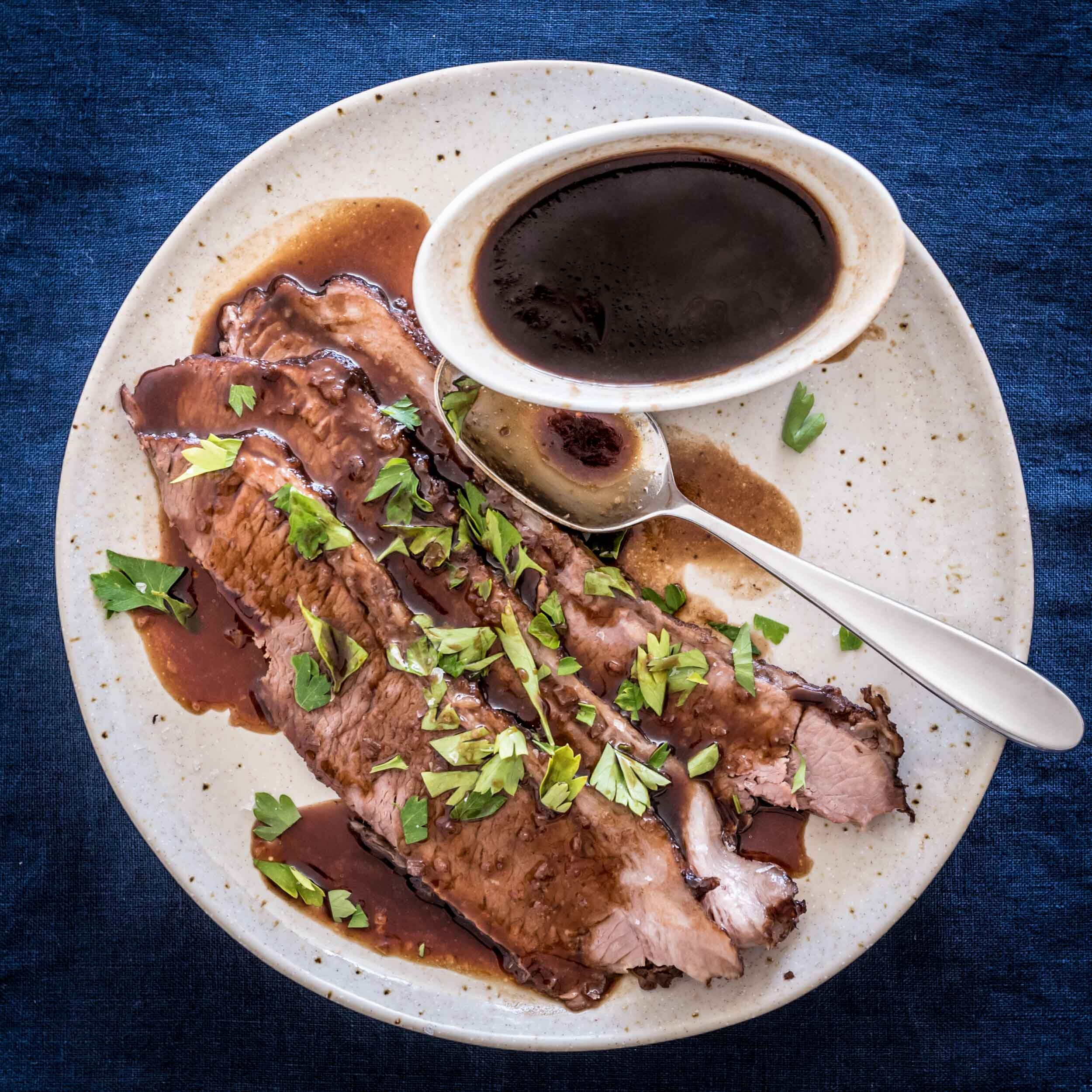
Brisket!
Note: this recipe was part of a book I wrote called Eat Like A Maisel.
Yield: 6–8 servings
You’ve gotta love Midge’s unwavering support of Joel’s comedy career, especially her knack for getting Joel better time slots. Stand-up can be a grind. In the current New York comedy scene, fledgling comedians perform on “bringer shows”—comedians bring paying audience members in exchange for a spot on the show. I perform at a club with a ten-person bringer requirement. When I first started out, I didn’t have ten friends (I still don’t) so I did favors (wink) for the producer.
Even if you don’t do stand-up, the Brisket can grease the wheels on any important thing you need done. Need your car fixed? Brisket. Want a promotion? Brisket. Need your neighbor to do some weird favor involving a snow shovel, some rope, and a petting zoo? Brisket.
This brisket is easy enough to be a weeknight meal but would be equally at home for a special occasion.
1 pound (453 g) carrots, 1⁄2-inch dice
1 pound (453 g) celery, 1⁄2-inch dice
1 pound (453 g) onions, 1⁄2-inch dice
1 brisket, 3–5 pounds, fat and silverskin trimmed (I prefer only a thin strip of fat on top)
Kosher salt, as needed
4 tablespoons (50 g) canola oil
1 750 ml bottle of dry red wine, such as cabernet sauvignon or merlot
32 ounces (1 L) beef stock
Maldon sea salt, as needed
Preheat the oven to 275 ̊F.
For the vegetables
Wash the carrots by running them under cold water and rubbing them with a clean dishrag. The point here is to dislodge any dirt. We’re not going to be eating the carrots in the end, so presentation isn’t as important. Dry the carrots with a fresh dish towel. Remove the root end and cut each carrot into 4-inch-long sticks. Cut lengthwise to halve each segment, then cut lengthwise again to quarter the carrots. Congrats, you’ve just made carrot sticks! We want 1⁄4-inch-thick dice for this preparation, so cut each stick crosswise into 1⁄4-inch-thick slices. You can group three or four sticks together to speed up this process. Set aside in a small bowl.
Remove the root end of the celery by cutting crosswise about 1 to 2 inches up from the root. You want to remove the root and the whitest parts of the celery. Separate the stalks and wash, using your fingers to dislodge any dirt. Dry, cut into 4-inch-long sticks, then cut crosswise into 1⁄2-inch- thick slices. Set aside in a small bowl.
Remove the top (opposite the root end) of each onion. Stand the onion on the cut side and cut in half through the root end. Remove the dry outer layers. With the large cut side down, slice downward every 1⁄4 inch, making sure not to cut all the way through the onion. Hold the onion from the top and make horizontal cuts every 1⁄4 inch. Now, make vertical cuts every 1⁄4 inch down the length of the onion. You’ve just diced an onion! Set aside.
For the brisket
Trim excess fat and silverskin. Salt the entire exterior of the brisket. Grab a few fingers’ worth of kosher salt and sprinkle over the meat from a height of at least 12 inches. Why so high? Because this results in a more even coating of salt. Don’t worry about the amount of salt you’re using here. This may seem like a lot, but remember, that there’s a lot of meat beneath the surface, and a lot of the salt falls off in the cooking process. Repeat for all sides of the brisket.
Heat 3 tablespoons of canola oil in a large pan over high heat. When the oil begins to shimmer, carefully add the brisket—try to avoid splattering everywhere, cussing, and having your spouse roll her eyes at you while suggesting you just order pizza and try to be a man. When the meat is browned on its first side, after about 2 to 4 minutes, flip it to another side. Repeat until all sides are browned, about 12 minutes total. If a side sticks, give it another minute instead of forcing it up. Once complete, remove the brisket from the pan and set aside. Spoon the fat out of the pan. It’s served its purpose, and will only dilute the flavor in the completed dish. Do not wipe the pan clean.
The pan should have brown stuff stuck to the bottom. This is good. This is flavor. We’re going to deglaze the pan, freeing up that yummy brown stuff. The brown stuff is technically called fond. And I’m fond of fond.
Turn the heat to medium, add the wine, and use a wooden spatula to scrape up the brown bits. This is called deglazing. Reduce the wine to a glaze, about 15 minutes. Remove from heat.
Add the brisket back to the pan. Optionally, and to make things easier in the final steps, cut a piece of cheesecloth larger than the pan and cover the meat. Add the onions, carrots, and celery on top of the cheesecloth. Add enough beef stock to cover everything. Gather the cheesecloth and place it inside the pan. Place the pan over high heat and bring the liquid to a simmer. Remember, simmer does not mean a boil. You should see water vapor coming off the top, but it shouldn’t be bubbling. Once it reaches a simmer, cover and place in the oven. Cook for 5 hours, or until the meat is fork tender. If you’re in a rush, you can increase the heat to 325 ̊F and cook for less time, but the meat won’t be as tender.
To complete
Remove the pan from the oven. Gather the edges of the cheesecloth, lift the vegetables out of the pan and reserve to a large bowl. Remove the brisket to a cooling rack to drain for a moment, and then transfer to a cutting board.
Heat the remaining liquid in the Dutch oven over medium high heat and reduce by half to concentrate the flavors. Reserve.
Slice the brisket across the grain into 1⁄4-inch-thick slices. Don’t know where the grain is? Grab a corner of the brisket and pull. You should end up with a long strand of meat. That is the direction of the grain. Cut across that. Arrange the slices on a serving platter. Scatter the reserved vegetables around the meat and drizzle some of the reserved sauce over the whole thing. Top with a few generous pinches of Maldon sea salt.

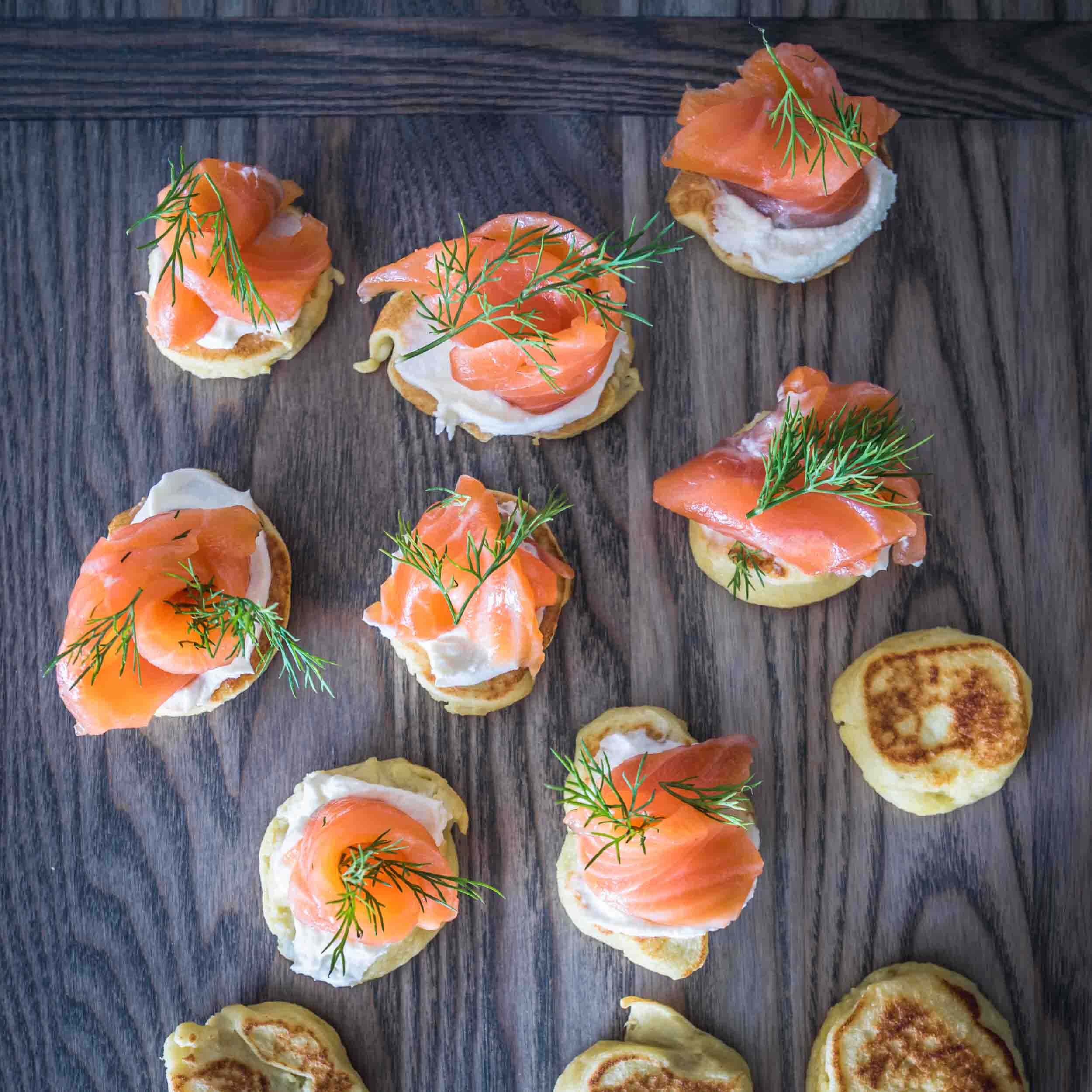
Blini!

Note: this recipe was part of a book I wrote called Eat Like A Maisel.
Yield: 20 blini
I love potato blini. Everything about them. They look cute. Feel cute. Even the name itself is cute.
Blini. It sounds like a sidekick in a Pixar movie, doesn’t it? Make a bunch of them, and they’ll be your little minions. They even kind of look similar.
They’re like little clouds on which you can layer different flavors. But whatever you top it with, make sure it’s flavorful. A common topper is caviar. Tiny, crunchy, salty. Is that what caviar tastes like? I don’t know, I’m not a Russian oligarch.
Here we top it with gravlax and deep-fried capers for a rich and salty crunch combo.
These will taste very plain on their own, severely lacking in salt. If you find yourself cursing my name, just take a deep breath and remind yourself, “These are supposed to be topped with something salty, like gravlax.”
You could easily top these with roasted red peppers for a vegetarian version. Or caramelized onions. Ohh, man, I’m getting hungry again.
1 pound (450 g) Yukon Gold potatoes
4 tablespoons (56 g) butter + more as needed
2 tablespoons (25 g) crème fraîche
2 eggs
2 tablespoons (20 g) flour
Maldon sea salt, as needed
Put potatoes in large pot and cover with at least 1 inch of cold water. Turn the heat to high. Once it comes to a gentle simmer, adjust heat to maintain just a gentle simmer. You don’t want a full boil, as it could damage the outsides of the potatoes. (If the outsides get damaged, the potatoes will begin to absorb water, which means they won’t absorb as much fat later!)
Cook until you can easily pierce the largest potato with a knife, about 30 minutes. It should slide in smoothly. You shouldn’t feel any starchy resistance once they’re fully cooked. If they’re larger, they could take as long as 40 to 50 minutes or longer. Keep that knife handy and, after 20 minutes of simmering, test every 10 minutes.
Drain in a large sieve (or your tamis!) or remove the potatoes from the water with a spider, skimmer, or whatever.
As soon as the potatoes are cool enough to handle, peel them with your fingers. Or, don’t peel them and place them directly on your tamis (more on this in a moment).
Meanwhile, put 4 tablespoons of butter and the crème fraîche into a large mixing bowl.
Put the potatoes through a ricer, food mill, or my favorite, a tamis. You can process the potatoes directly into the bowl. If you feel more comfortable handling the tamis, you can place a sheet of parchment paper directly on your countertop and process the unpeeled potatoes through the tamis right onto that sheet.
If you didn’t process the potatoes directly into the bowl, add them to the bowl with 4 tablespoons of butter and the crème fraîche. Use a wooden spoon and mix to incorporate.
Add the eggs one at a time and stir to incorporate. You’re going for the texture of pancake batter. Add some of the flour to thicken if necessary.
Heat a medium nonstick skillet over medium low heat. Add a small pat of butter to the pan and swirl the pan to coat. Spoon flatware teaspoon-sized dollops of batter into the pan and cook until browned on one side, about 4 minutes. Flip the blini and cook for until browned on the other side.
Serve with gravlax, caviar, or just a small dab of crème fraîche and a pinch of Maldon sea salt.

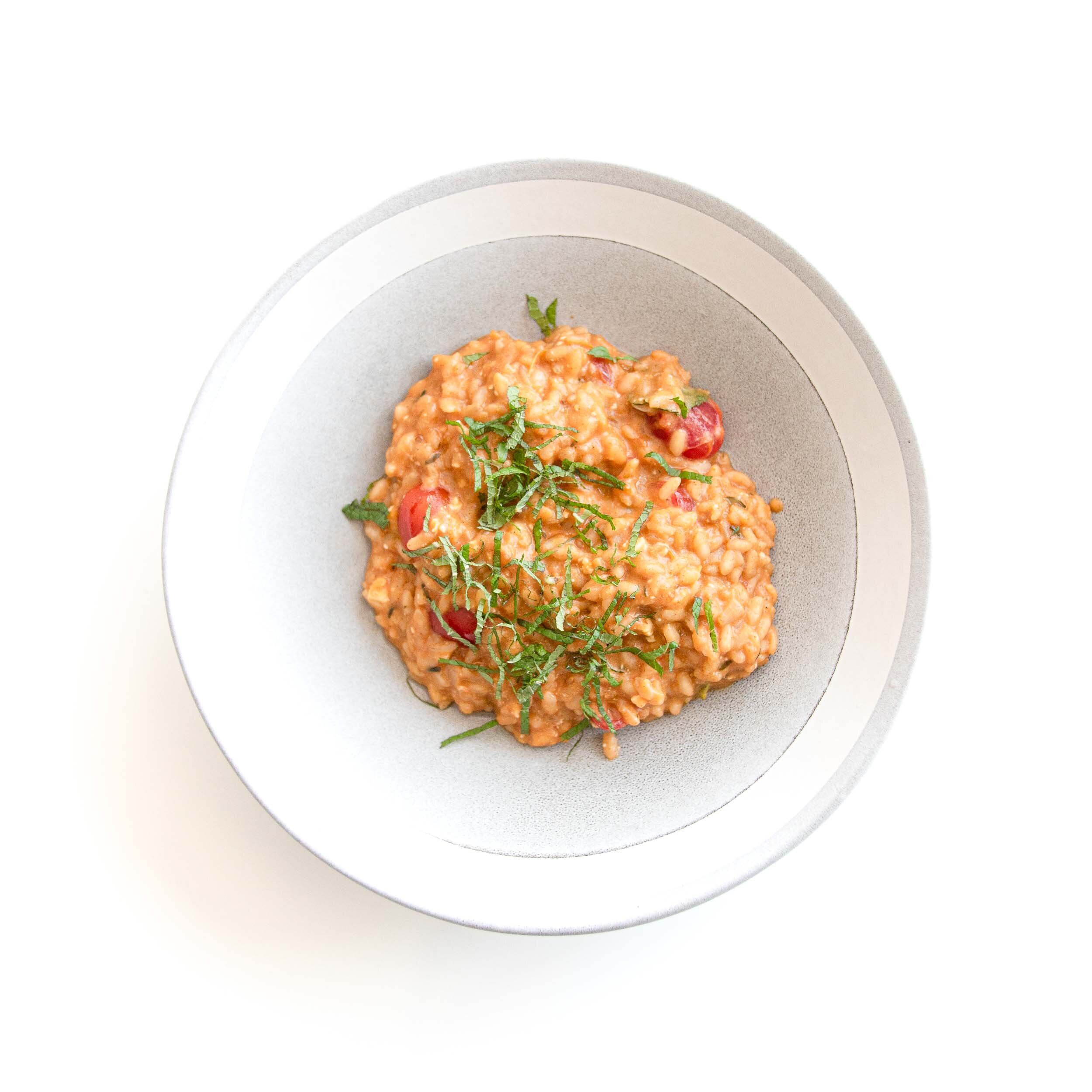
Risotto, tomatoes, feta, paprika

Yield: 2 servings
Risotto isn’t difficult to get right. It’s impossible.
Cook it too fast, and it’s soupy undercooked rice. Too slow? And you’ll never get dinner on the table.
What is it about risotto that makes me want to take a nap midway through?
Try as you might to follow a recipe from a famous chef (like me), it never turns out as easy as they claim or as sexy as the pictures look. Oh, you might get close. You might get 90 percent through the recipe, and think to yourself “I’ve got this!”
You do not got this.
It can be daunting, like doing stand-up right after Lenny Bruce. Here’s my suggestion: take the pressure off yourself. Treat each batch of risotto as a learning experience, have a glass of wine, take a Xanax, relax. You’ll get through it. And you’ll come out a better cook because of it.
32 ounces chicken stock or vegetable stock
4 tablespoons (56 g) butter, divided
2 tablespoons (25 g) olive oil
1 pound (453 g) onions, 1⁄2-inch diced
1⁄2 cup (100 g) Carnaroli risotto
2 teaspoons (8 g) kosher salt
1⁄2 cup (120 g or 120 mL) dry white wine, such as pinot grigio
1 bunch (20 g) thyme, tied with a piece of kitchen twine
1 heaping cup (120 g) cherry tomatoes, halved
2 tablespoons (2 g) thyme
2 teaspoons (6 g) sweet or smoky paprika. Doesn’t matter!
1⁄2 cup (80 g) feta, crumbled
1⁄2 loosely packed cup (3 g) mint
Add chicken stock to a small saucepan, simmer over medium heat.
Add 2 tablespoons butter and olive oil to a large saucepan over medium heat. Add onions to pan and sweat until translucent. Add risotto to the pan and increase heat to medium-high to toast the risotto, stirring continuously to prevent burning. Add the salt and white wine to the pan, stir to incorporate, and cook until the liquid has evaporated.
Add the cherry tomatoes, thyme, and paprika to the pan. Stir to incorporate.
Add 1⁄2 cup of chicken stock to the pan, stir constantly, and cook until the liquid has been fully absorbed. Continue adding stock 1⁄2 cup at a time and stirring until the liquid has been absorbed.
When the risotto is al dente, remove from the heat and stir in the feta, 2 tablespoons butter, and mint. It’s important to stir vigorously at this point. The harder you stir it, the more emulsified the butter and cheese will be. Serve immediately.

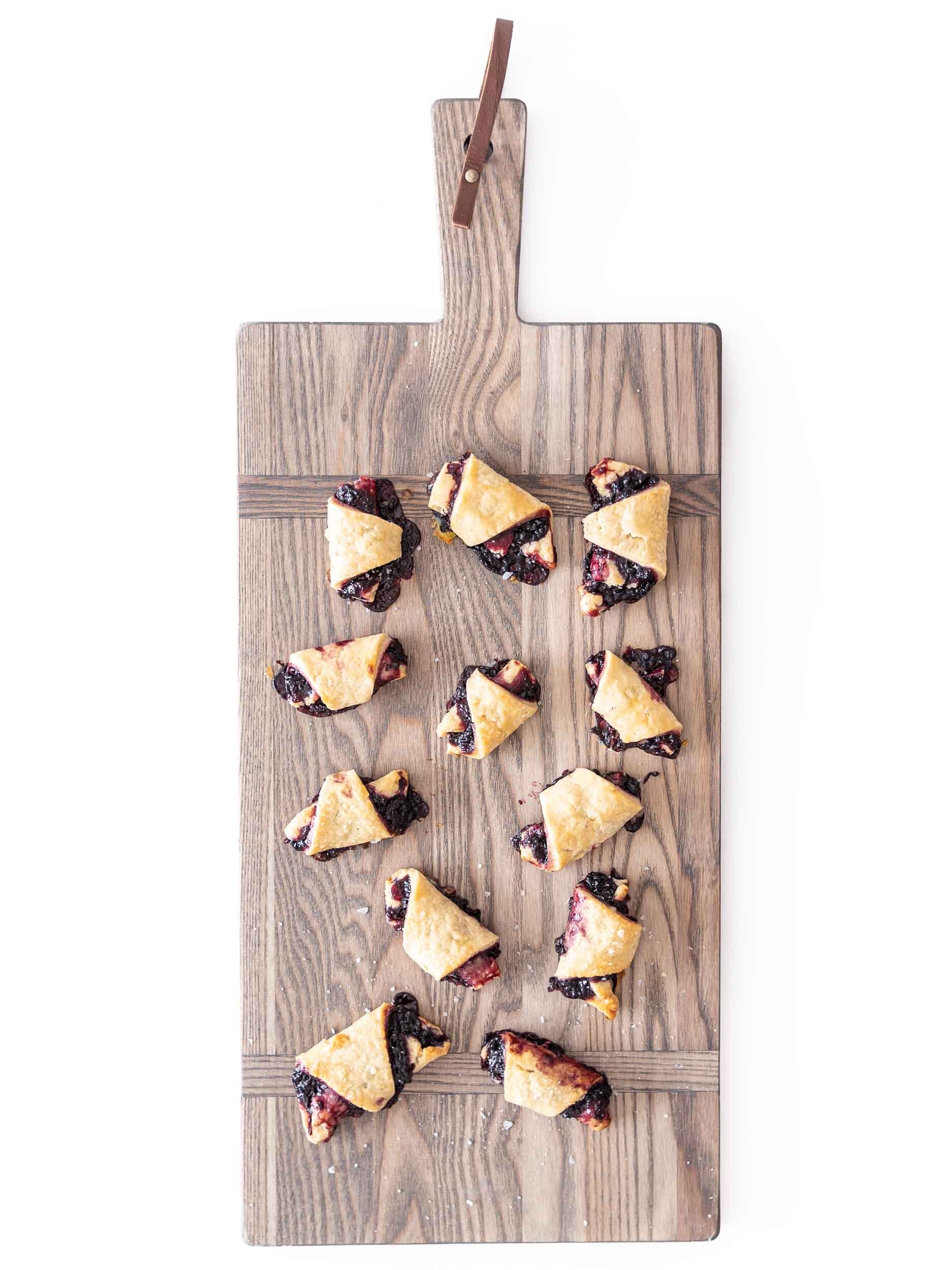
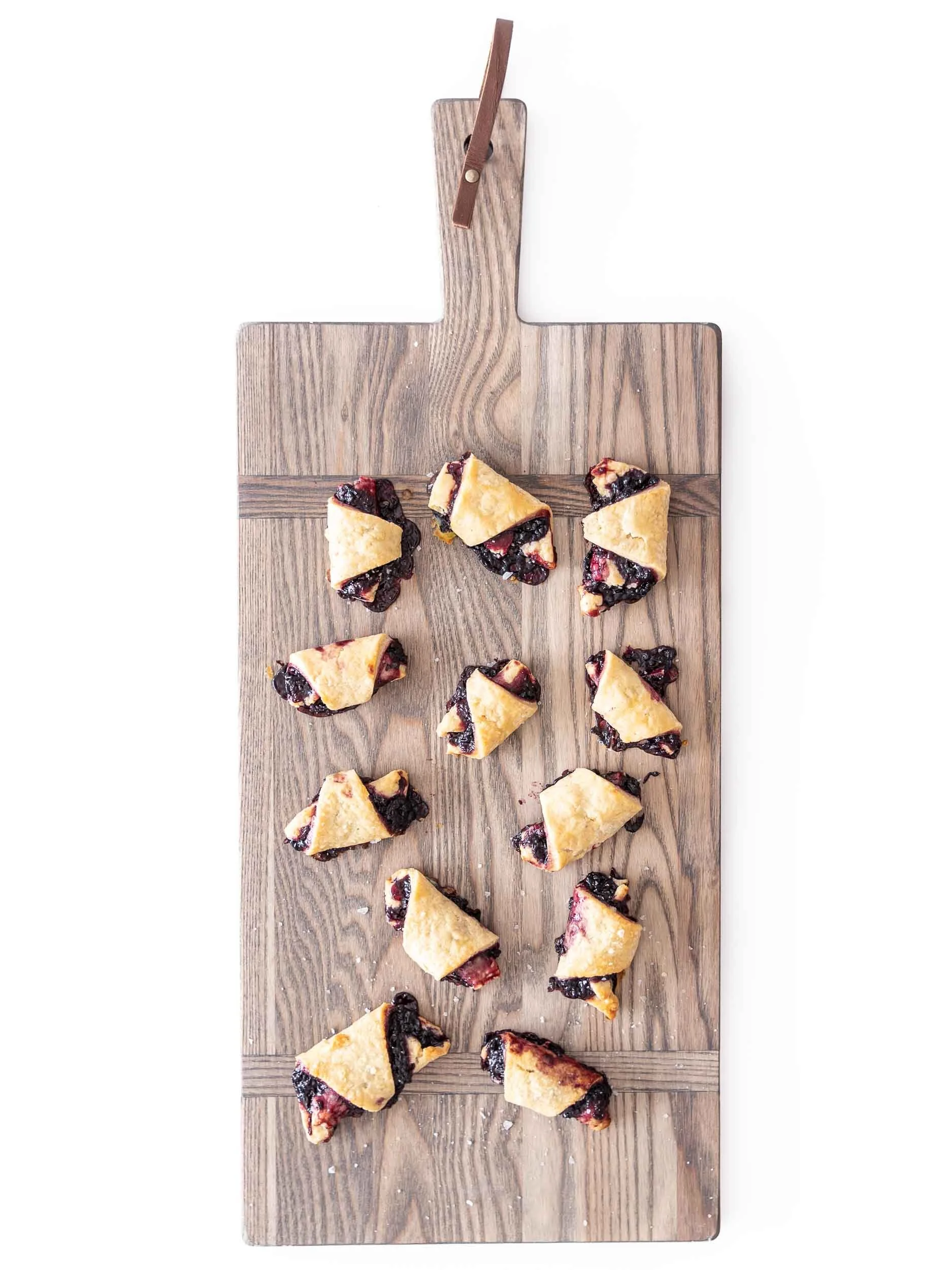
Brown Butter Rugelach
Note: this recipe was part of a book I wrote called Eat Like A Maisel.
How much do I love Herb Smith? Exactly as much as Vern, with every bone in my body.
He’s is one of my favorite cameos. Such confidence, such charisma, and such poor joke-writing skills. Did anyone else want him to tell Midge “never wage a land war in Asia” and “never go against a Sicilian when death is on the line”? I kept waiting for him to laugh hysterically and tip over. That never arrived. But his pickle did! (The pickle’s funny.)
I loved his giant order at the Stage Deli. “A half pastrami on rye, and a half-chopped liver on challah, a stuffed cabbage, some kasha varnishkes, and a bit of arugula.” The first time I watched, I thought his order contained “a bit of rugelach.” When I rewatched it with the captions—after I decided to include this rugelach recipe, and after I wrote, tested, and photographed it—I found out he actually ordered arugula.
So.
Here’s a bit of rugelach for you. I’m sure Herb would’ve appreciated the surprise with his order if the waitress had misheard, too.
Yield: 16 cookies
4 ounces (114 g) butter, divided
4 ounces (114 g) cream cheese
1 cup (150 g) flour
1⁄4 teaspoon (1 g) kosher salt
1⁄2 cup (100 g) jam of your choice (I love blackberry, raspberry, or a combination of the two.)
1 egg (55 g)
Maldon sea salt, as needed
Turbinado sugar, as needed
Add half the butter to a large mixing bowl. Set aside.
Add the remaining butter to a small skillet over medium heat. You don’t need to stir. It will melt, then bubble, then brown. Watch it closely once it starts smelling nutty. It doesn’t take much time to go from brown to burned. Pour it into the bowl containing the rest of the butter. Use a silicone spatula to scrape all the little brown bits into the bowl.
Add the cream cheese to the bowl and stir to mix the ingredients together. You only need to mix enough so that you don’t splatter the liquid everywhere in the next step. (I found this out the hard way . . .)
Use an electric hand mixer to cream the butter and cream cheese in a large bowl. Add the flour and salt and mix on low until incorporated.
Turn out the dough onto a piece of parchment paper and compress it into a ball. Wrap with plastic wrap and refrigerate for at least 2 hours or up to 24 hours.
Line a large baking sheet (or two smaller baking sheets) with parchment paper. Set aside.
Divide the dough in half. Place one half, flat-side down, onto a piece of parchment paper. Cover with another piece of parchment paper and roll into a disc about 9 inches wide. It’s okay if the sides crack while you’re rolling. Depending on how much of a perfectionist you are, you can pull off the cracked parts and press them into other parts of the dough to make it more disc like.
Spoon half the jam onto the disc. Use a paring knife to slice the discs into 8 equal wedges. Roll each wedge in on itself, starting with the wide end and working inward, and place on the parchment paper–lined baking sheet.
Refrigerate for at least 20 minutes. Preheat the oven to 375 ̊F.
Beat the egg in a small bowl. Use a small brush to paint each rugelach with egg. Sprinkle with Maldon sea salt and coarse sugar.
Bake for 15 to 20 minutes, or until the rugelach are golden brown.

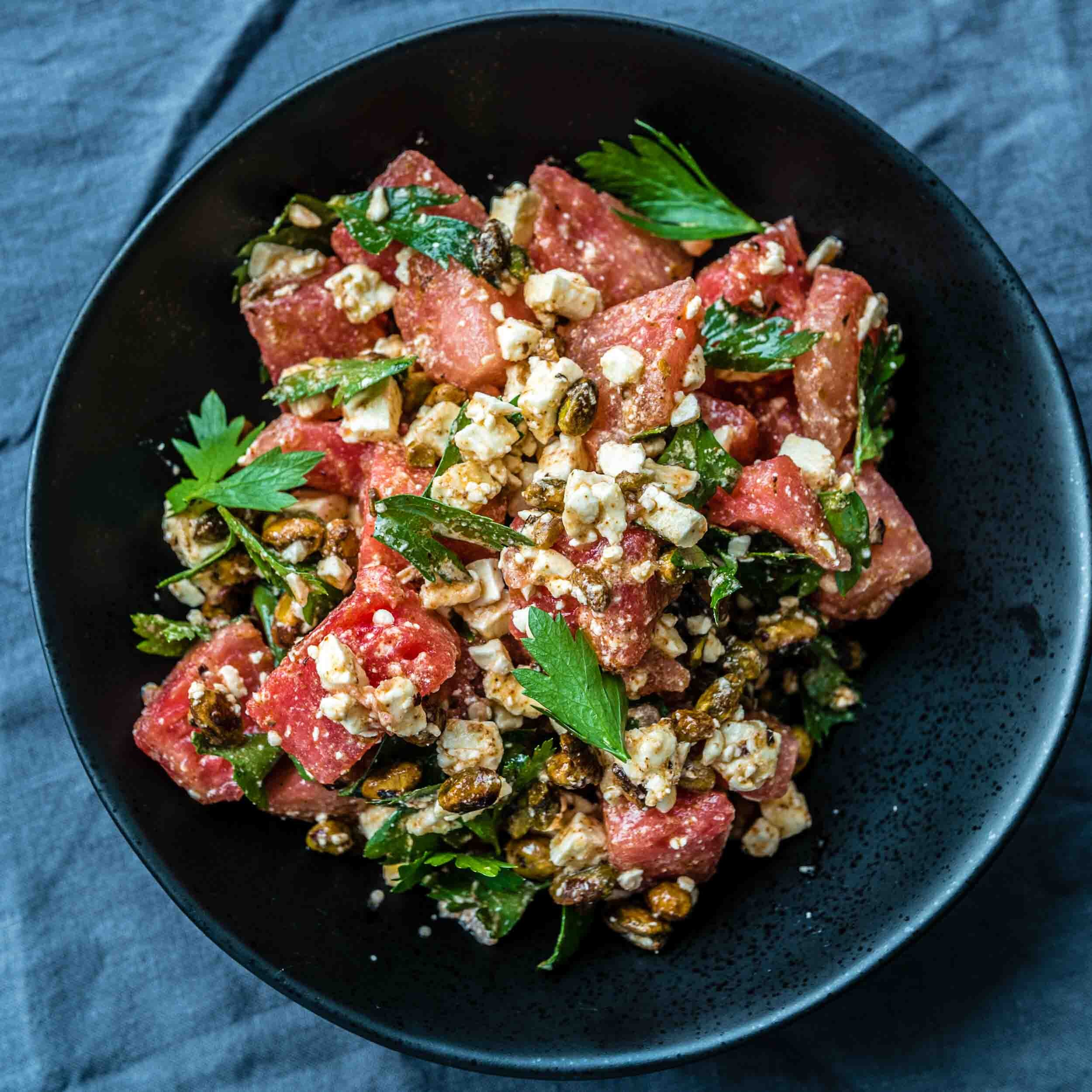
Watermelon salad, feta, mint, EVOO, harissa

Note: this recipe was part of a book I wrote called Eat Like A Maisel.
Yield: 4 servings
How beautiful is this salad! So good. So pink. So salady. But not too salady. Almost no green stuff, save for a few leaves of mint and pistachios, if you can count those. Use the ripest watermelon you can. The melon should feel heavy for its size and should sound hollow.
1 pound (453 g) watermelon, 1-inch cubes
a heaping 1⁄2 cup (100 g) feta cheese
1/3 cup (40 g) pistachios
2 tablespoons (25 g) olive oil
Kosher salt, to taste
1⁄4 cup mint
1 tablespoon harissa powder
8 tablespoons parsley
Add all ingredients to a large bowl and mix to combine. Divide among 4 serving bowls. Garnish with parsley.

Chickpea and Olive Salad
Note: this recipe was part of a book I wrote called Eat Like A Maisel.
Yield: 4 servings
The Weissmans eat salad more than a few times during the first season. Their tastes generally lean toward a simple lettuce salad—which surely has more to do with Zelda’s laziness than the fact that it’s a prop—but I think they’d welcome a change. Should Rose ever ask me for a suggestion, I’d offer this salad. I think it would be as equally welcome on the Weissmans’ table as Ethan is in front of the TV (or as the daughter is to being written out of the script).
3 tablespoons olive oil
2 teaspoons fresh squeezed lemon juice
1 can chickpeas, rinsed
1 cup kalamata olives
1 English cucumber, 1⁄2-inch dice
3 tablespoons red onion, 1⁄4-inch dice
1⁄4 cup flat-leaf parsley
1⁄2 cup feta
Whisk together the olive oil and lemon juice in a large bowl. Add all the ingredients and toss to combine.
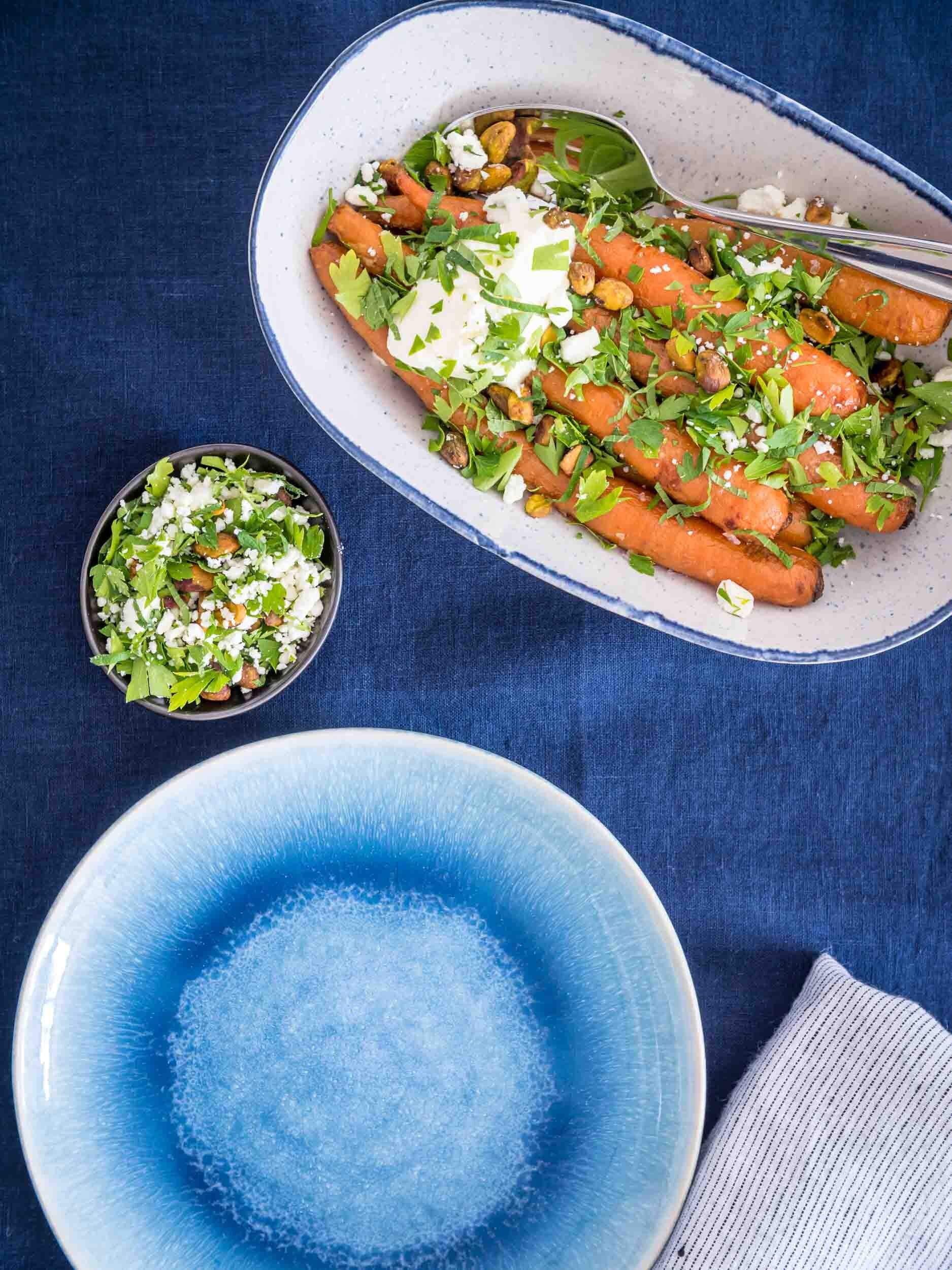
Butter-Roasted Carrots

Note: this recipe was part of a book I wrote called Eat Like A Maisel.
Yield: 4 servings
Maybe Zelda has the night off. Or you’re more focused on a main item, like the Brisket (page 142) or the Rack of Lamb (page 151). Or maybe you just feel like a bunny. Doesn’t matter. This dish is easy, tasty, and the pop of color and textures from the parsley, mint, pistachios, and feta make for a nice surprise.
1 pound (453 g) carrots
1 pound (453 g) butter
4 tablespoons (5 g) parsley
8 tablespoons (2.5 g) mint
1⁄4 cup (40 g) feta
1⁄4 cup (30 g) pistachios
Kosher salt, to taste
4 garlic cloves, optional
1 bunch (20 g) thyme, tied with a piece of kitchen twine, optional
Wash the carrots, scrubbing vigorously. Wrap a clean dishrag around the carrot and push and pull the carrot through it. Seriously. You’re going to be uncomfortable. You’re going to make anyone watching you uncomfortable. But when you’re done, the carrots should have a soft, velvety skin. Which I think makes this whole exercise even more awkward.
Melt butter in a large sauté pan. You want a pan small enough to fit the carrots, but not so large that you have tons of extra room. I used a 12-inch cast iron skillet. You can chop them into shorter lengths if you wish, but I prefer the presentation of full-length carrots.
Add the carrots to the pan. Careful! Don’t splash any of that butter. This is the time to add the optional garlic and thyme.
Preheat the oven to 300 ̊F.
Carefully move the carrots to the oven and roast for 2 hours. If the carrots aren’t completely covered in butter, rotate or baste them occasionally so they don’t dry out.
Remove from oven. Transfer the carrots to a cooling rack on an aluminum foil–lined baking sheet. Transfer the butter in the pan to a jar. Congrats, you just made carrot-flavored ghee! Use this as you would butter, keeping in mind that it’ll have a subtly sweet flavor.
Toss the carrots with parsley, mint, pistachios, feta, and salt (to taste) and serve.
