Recipes
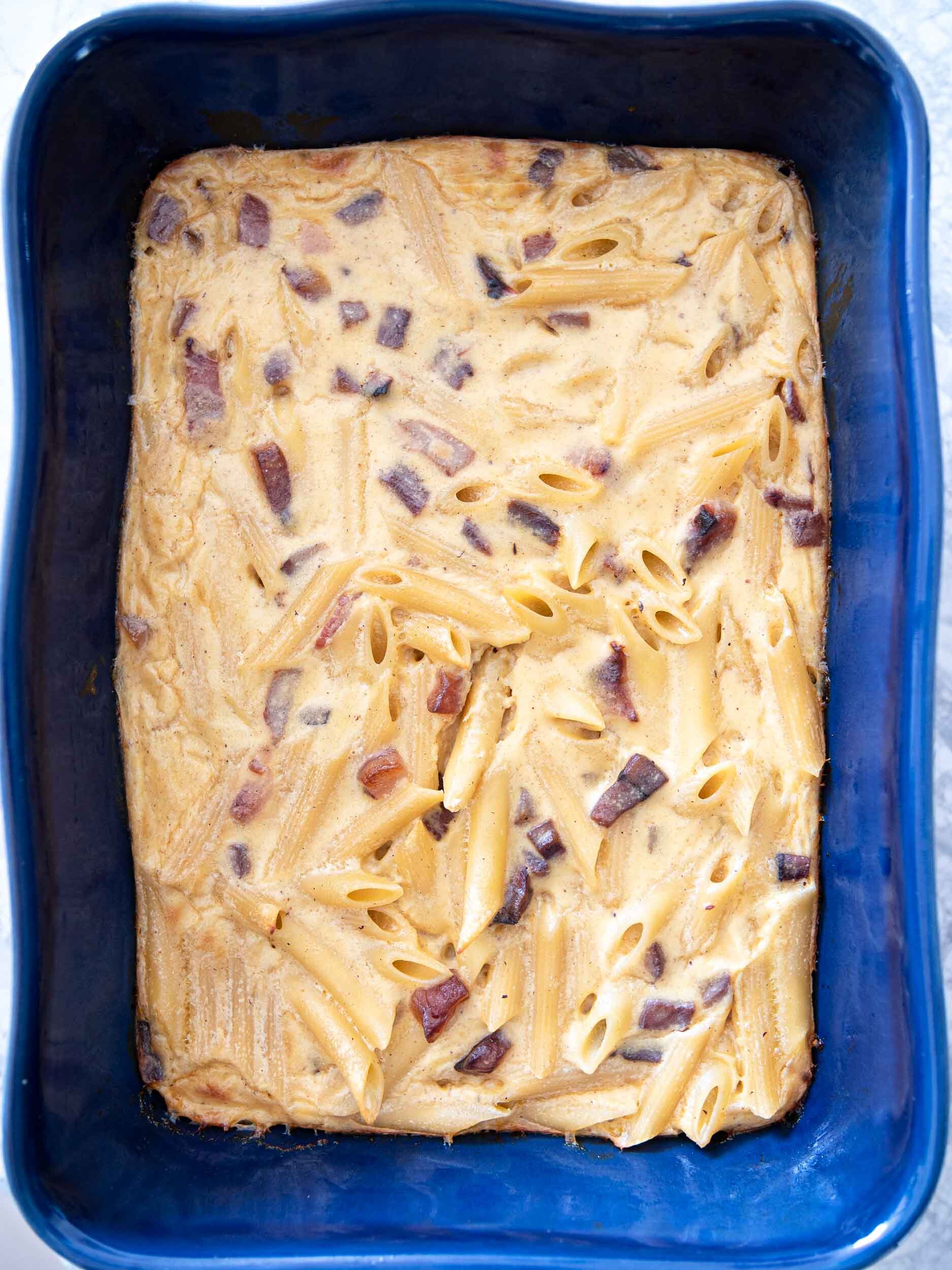
"Bacon & Eggs" Noodle Kugel

Note: this recipe was part of a book I wrote called Eat Like A Maisel.
When I was a kid, I took casseroles for granted. I didn’t understand the complex mathematical formula of nutrition, bulk, and ease that a casserole affords to a parent.
You mean, I can combine everything in one pan, throw it in the oven, and when I pull it out, I’ll have a happy and full family? Done and DONE!
The downside with casseroles is they tend to lack texture. They fall into that slow-cooker style of texture-less mush.
But they don’t have to!
This is one of those dishes where no matter how much extra you THINK you have, you’ll find a way to demolish the entire thing faster than your elastic waistband can expand.
If you happen to succeed in saving leftovers, it’s perfect for breakfast the next day. I like to perform a magic trick in the morning: I cut a giant square, nuke it for 30 seconds, and surprise everyone with how quickly I eat it.
I get why moms were so into casseroles. They’re easy, tasty, and 100 percent healthy. (Don’t fact-check that.)
Guanciale is cured pork cheeks (the front ones). If you can’t find it, use pancetta. If you can’t find pancetta, use bacon. If you can’t find bacon, you probably aren’t living on Earth, in which case, you should come visit sometime! Bacon’s the best thing we’ve got!
1⁄2 pound guanciale, cut into lardons, 1⁄4 inch by 1⁄4 inch by 1 inch
7 tablespoons (100 g) butter
1 tablespoon (10 g) flour
4 cups (1000 g) milk
8 egg yolks
41⁄2 ounces (125 g) Parmigiano-Reggiano cheese, freshly grated
2 teaspoons (6 g grated) nutmeg
1 pound (453 g) penne pasta
Heat oven to 350 ̊F.
Add guanciale to a cold skillet large enough to fit it all on one layer. Turn heat to high. Turn heat to low as soon as you hear the sizzle. Cook until one side is browned, then flip each lardon and brown the other side. Once done, transfer guanciale to a paper towel–lined plate.
Make the roux. Melt butter in a small saucepan over medium heat. Add flour to the saucepan, increase heat to medium-high, and stir constantly. You want it hot enough to cook out some of the flour flavor but not so hot that it starts browning. Reduce the heat if it starts browning. Add milk and bring to a simmer while stirring. Simmer for a minute and then remove from heat. Set aside. Let cool for 5 to 10 minutes so it doesn’t cook the egg mixture.
Beat egg yolks to combine in a bowl. Add cheese, nutmeg, and roux. Stir to combine. Set aside.
Bring a small pot of salted water (remember, it should taste like the sea) to a rolling boil. Cook the pasta for 4 minutes. Strain and discard the cooking water.
Transfer pasta to a 8 by 8–inch casserole dish. Add the guanciale and then the custard mix. Bake 30 to 45 minutes at 350 ̊F.

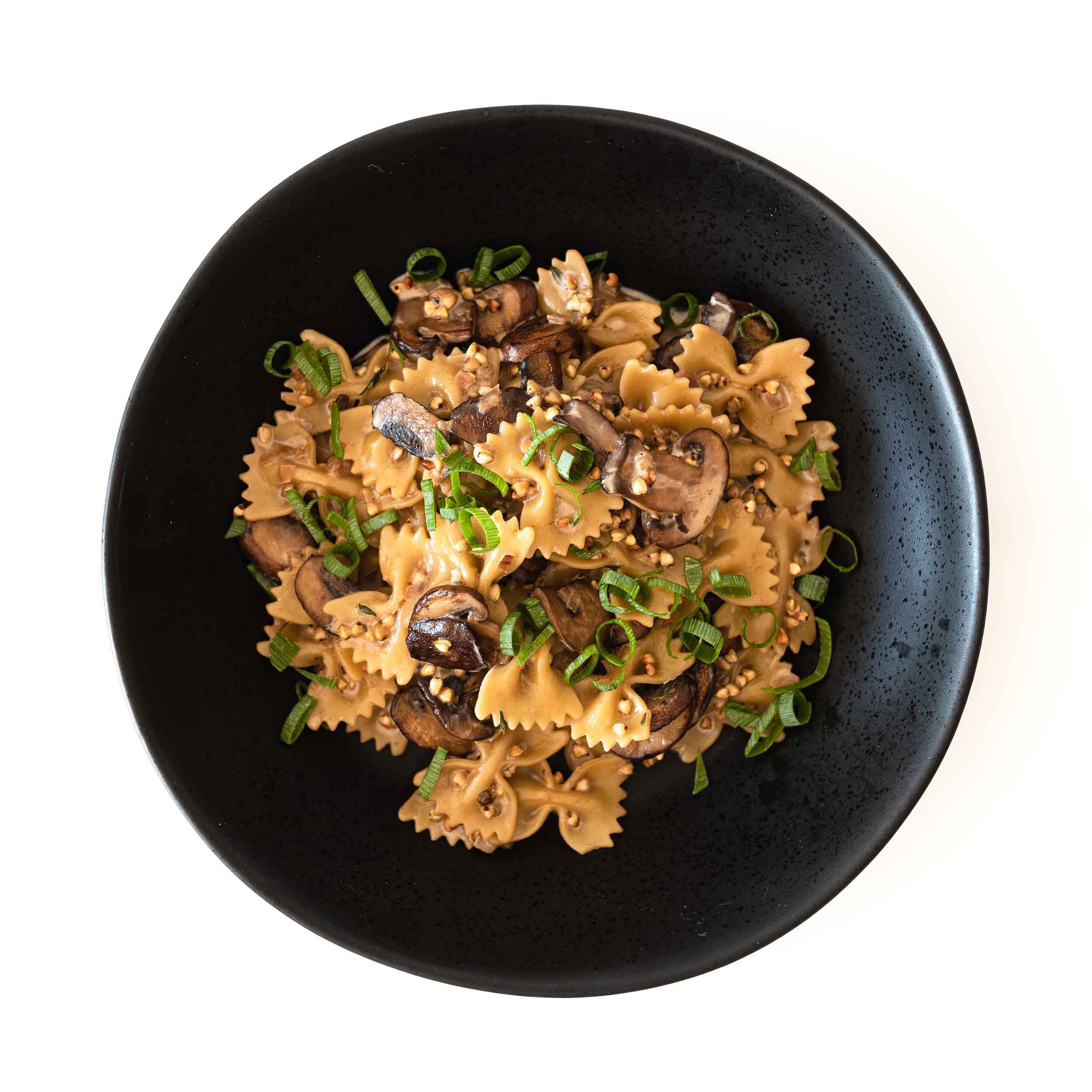
Kasha Varnishkes

This post contains affiliate links. As an Amazon Associate I earn from qualifying purchases—if you buy through them, it costs you nothing extra and helps keep this site running.
Updated: July 12, 2026
Note: this recipe was part of a book I wrote called Eat Like A Maisel.
Yield: 2 servings
“Half pastrami on rye, half chopped liver on hallah, stuffed cabbage, some kasha varnishkes, and a bit of arugula. Extremely Jewish and extremely hungry. The pickle’s funny.”—Herb Smith.
“DOINK.”—Herb Smith
“Don’t trust a guy who will work for salami.”—Susie Myerson
This is not your Bubbe’s Kasha Varnishkes. This is my Kasha Varnishkes, my take on the classic comfort dish. Same old kasha. Same old varnishkes. With a twist!
I couldn’t bring myself to include just another KV recipe in this book. You can search all over the internet for standard KV. You’ll find some variation of: kasha, bow-tie pasta, onions, egg, schmaltz.
If Herb Smith ordered KV and got this, he’d probably wonder when the owners of the Stage Deli sold to gentiles.
I’m gonna come right out and say it: I don’t get kasha. I’m sure it’s a favorite for some people. Or they grew up with their Bubbe making it for Yom Kippur. I tried it the conventional way and I just couldn’t get behind it. So, I changed it. It still has kasha. It still has varnishkes. It still has schmaltz. But it also has some other stuff.
Ingredients
1⁄4 cup (50 g) kasha
4 tablespoons (50 g) rendered chicken fat or olive oil
1⁄4 pound (40 g before prepping) shallots,
1⁄4-inch dice
1⁄2 pound (225 g) mushrooms
1⁄2 cup whole milk
1⁄4 cup (75 g) heavy cream
4 tablespoons fresh thyme
Water, as needed
Kosher salt, as needed
2 cups (100 g) bow-tie pasta
Directions
Add the kasha to a sauté pan set over medium heat until toasted. Give them a gentle shake every minute or two to toast evenly. It’ll smell nutty. Nutty is good. Transfer the toasted kasha to a small bowl. Set aside.
Add the oil to a large skillet set over medium heat. Add the shallots to the pan. If they start browning, reduce the heat to medium-low.
Add the mushrooms to the pan, toss or stir to combine, and increase the heat to medium-high. Sauté until the mushrooms are browned.
Add the milk, heavy cream, and fresh thyme to the pan, reduce heat to medium, and reduce the liquid by half.
FOR THE PASTA
Fill a large saucepan halfway with water. Add salt as needed. I’m a nerd and weigh my water and salt, adding 1% of the water’s weight in salt. So if I add 3 liters of water, which is 3 kg (3000 grams), I’ll add 30 grams of kosher salt. Please salt your pasta water. It’ll make this dish taste so much better.
Cook the pasta 1 minute less than the package directions.
TO COMPLETE
Use a spider (👈🏿 affiliate link) to transfer the pasta to the pan with the mushrooms. It’s okay if some of the pasta water comes with it. It’ll help season the mushrooms.
Add 1⁄4 cup of the pasta water to the pan and simmer for 2 to 3 minutes. Divide among two plates. Garnish with fresh chives and/or more fresh thyme.

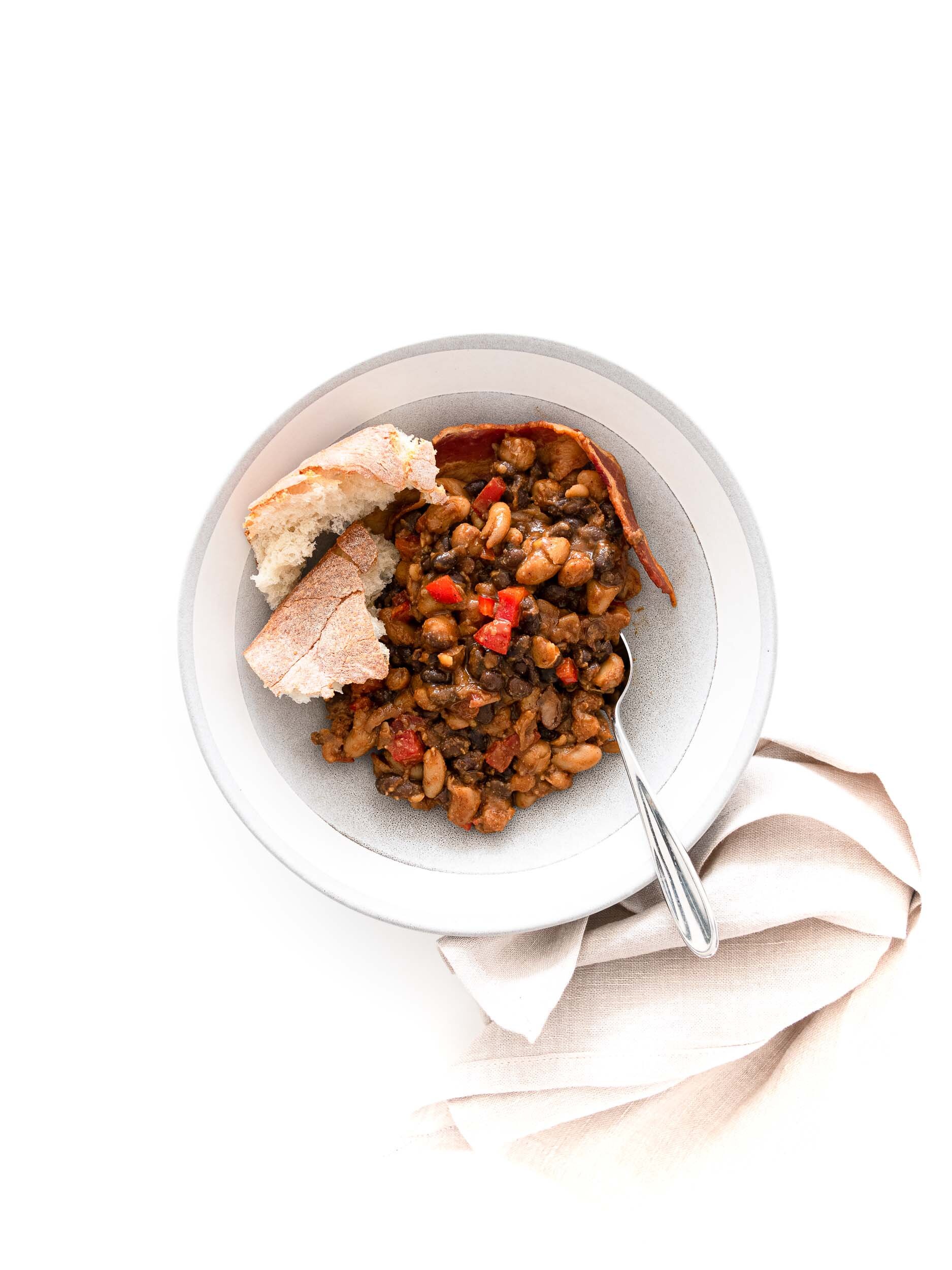
Susie's Beans

Note: this recipe was part of a book I wrote called Eat Like A Maisel.
Yield: 4–6 servings
I love Susie’s practicality. She eats a can of beans right out of the pan she warmed them in. But she deserves better. This dish pays homage to the original recipe (open can, eat) but introduces some variety in the beans and some interest in the flavors. The ingredient list is long, but you’ve probably got everything except the bell peppers on hand already.
I use Better Than Bouillon and water here instead of chicken stock to keep this simpler, more Susie-ish. I use so much chicken stock at home, I find it’s easier to keep a small jar of Better Than Bouillon in the fridge than jars and jars of chick stock.
7 ounces (200 g) bacon
1 (16-oz) can black beans, rinsed
1 (16-oz) can garbanzos, rinsed
1 (16-oz) can cannellini beans, rinsed
3 cups (750 ml or 750 g) water
1 tablespoon Better Than Bouillon, chicken flavor
1 teaspoon (1.5 g) cumin
2 teaspoons (3 g) chili powder
2 teaspoons (3 g) smoked paprika
1 teaspoon (1.5 g) cayenne, optional if you want a kick
1 teaspoon (1.5 g) dried oregano
1 1⁄2 cups (200 g) red bell pepper, 1⁄4-inch dice
1 1⁄2 cups (200 g) green bell pepper, 1⁄4-inch dice
crème fraîche, optional
Cheddar cheese, optional
Fritos, optional
Green onion, optional, sliced
Cook the bacon. Place bacon slices on a cooling rack placed on an aluminum foil–lined baking sheet. Put into a cold oven. Set to 400 ̊F and cook until crispy, 20 to 25 minutes.
Add all ingredients except the bell pepper and bacon to a large pot and cook over medium heat until simmering. Reduce heat to low and cook until liquid reduces to the texture of chili, about an hour. Add the diced bell pepper at the end and stir to combine.
Divide among serving bowls and top with crème fraîche, grated cheddar cheese, Fritos, and/or sliced green onion. Or eat them straight out of the pan, like Susie does.

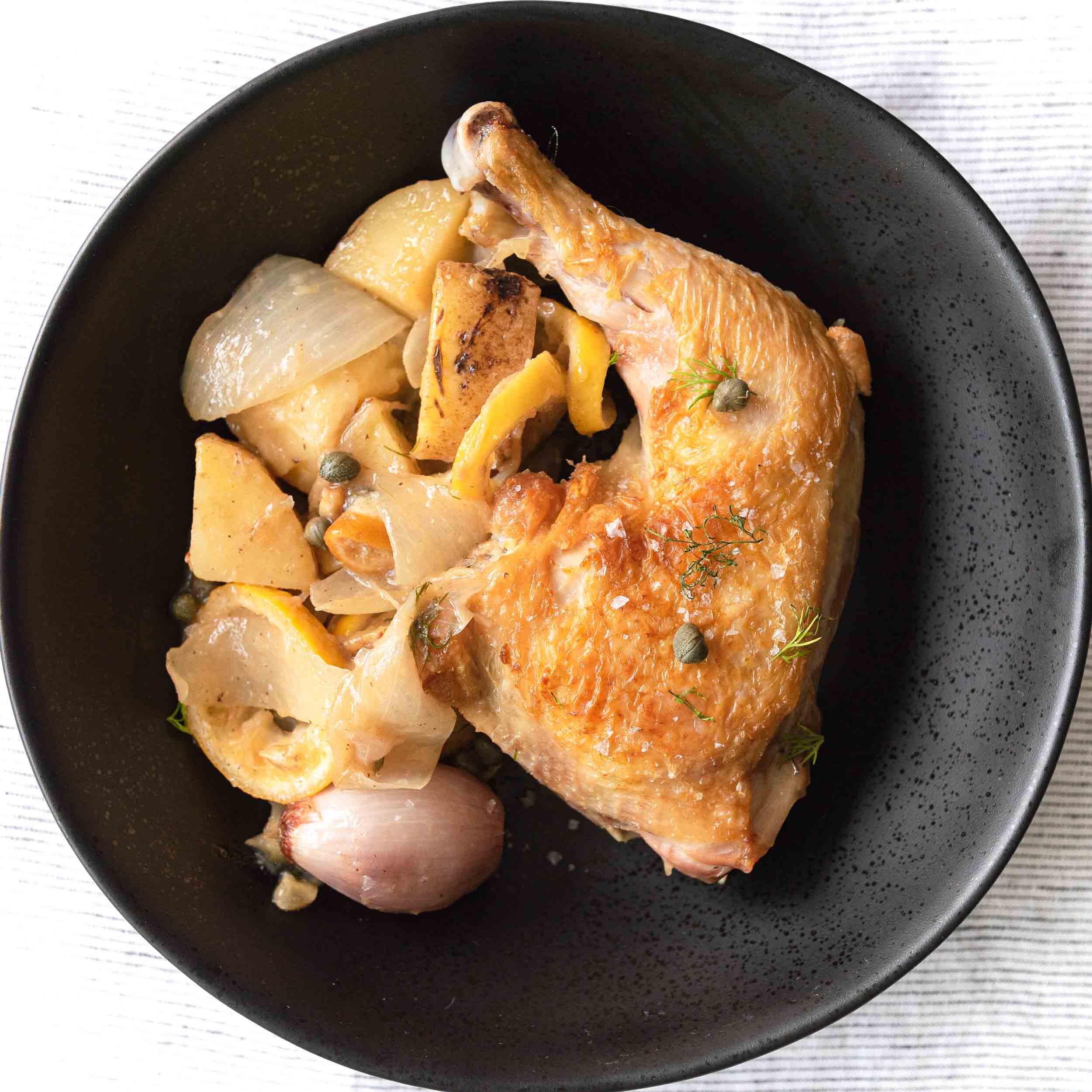
Braised Chicken Thighs

Note: this recipe was part of a book I wrote called Eat Like A Maisel.
Zelda deserves a few nights off, for all she does for the Weissmans.
4 chicken thigh and leg quarters (4 thighs and 4 legs)
Kosher salt, as needed
4 tablespoons (50 g) canola oil
8 cloves garlic (6 g)
1 pound (453 g) potatoes, 1⁄2-inch dice
2 onions, cut into wedges
1⁄2 pound (225 g) shallots
1 lemon, 1/8-inch slices, plus 1 lemon, halved, for lemon juice garnish
4 tablespoons (30 g) capers
4 tablespoons (30 g) green olives, diced
4 tablespoons (10 g) dill
4 tablespoons (10 g) parsley, for garnish
Preheat the oven to 350 ̊F.
Pat the chicken dry with paper towels. Season with kosher salt.
Add oil to a heavy-bottomed Dutch oven and heat over medium heat. Add chicken skin-side down and cook for 8 minutes. Remove the chicken to a cooling rack on a foil-lined baking sheet.
Smoosh (technical term) garlic under the broad side of a chef’s knife. Leave the skin on and add to the pan. Cook until the garlic is lightly browned, tilting the pan to cook the garlic in pooled oil. Once the garlic is browned, remove and discard.
Add the potatoes, onions, shallots, and lemon wheels to the pan. Place chicken on top of the vegetables and move the pan to the oven. Cook, uncovered, for 45 minutes, or until chicken is cooked through. You can use an instant-read thermometer to test for doneness (155 ̊F). Chicken legs are pretty forgiving to overcooking, so I tend to just go by time.
To complete, divide the potatoes and onions among 4 plates and place the chicken on top. Top with capers, olives, dill, a squeeze of lemon, and parsley.

Crème Fraîche Cheesecake

Last updated: February 18, 2026
Note: this recipe was part of a book I wrote called Eat Like A Maisel.
Yield: 2–4 servings
Why does everything have to be so sweet all the time? America loves sugar. Ohhh boy, do we love sugar. Our Cromag brains go bonkers when we taste sugar.
I’m done with all the sweet. I want bitter. And salty. Maybe a little sour in there for good measure.
Enter the Crème Fraîche Cheesecake. This is a dessert for people who don’t like things too sweet. It looks sweet. Sounds sweet. But it’s not too sweet. A lot like Midge. She looks like a nice, normal 1950s housewife but when she gets on stage, there’s a whole other side of her.
Ingredients
For the Cheesecake
4 ounces (114 g) cream cheese
1⁄4 cup (100 g) crème fraîche
11⁄2 tablespoons (40 g) sugar
1⁄4 cup (60 g) heavy cream
1⁄2 vanilla bean
1 egg
For the Graham Cracker Topping:
8 (60 g) graham crackers
1⁄2 cup (60 g) pistachios
1 stick (113 g) butter
Salt, to taste
Directions
For the cheesecake
Use an electric hand mixer to beat the cream cheese and crème fraîche in a large bowl until smooth. Add the sugar and cream and beat to mix until smooth again. Use a paring knife to cut a vanilla bean in half and reserve the other half for another use. Slice down the vanilla bean half to open the bean and expose the seeds inside. Take care not to cut all the way through the vanilla bean. Open the pod by folding the sides back and slide the knife down the length of the bean to scrape out all the seeds. Add them to the bowl along with the egg and beat to combine.
Preheat the oven to 325 ̊F. Put the mix in a 4-inch by 13⁄4-inch springform pan, place it on a parchment paper–lined baking sheet, and put it in the oven. Bake until the cake is set, about 25 to 30 minutes. It should still wobble a bit in the center.
For the topping
Add graham crackers and pistachios to a food processor fitted with the blade attachment. Process until it’s a fine meal.
Add butter to a small skillet over medium heat. It’ll melt, then bubble, then bubble smaller bubbles. When it smells nutty, remove from heat and pour into the graham cracker mixture.
Stir. It’ll look like wet sand. After it cools a moment, taste it and add salt to taste. I usually add 1⁄2 teaspoon, but add as much or as little as you like. Refrigerate until ready to serve, at least 2 hours.
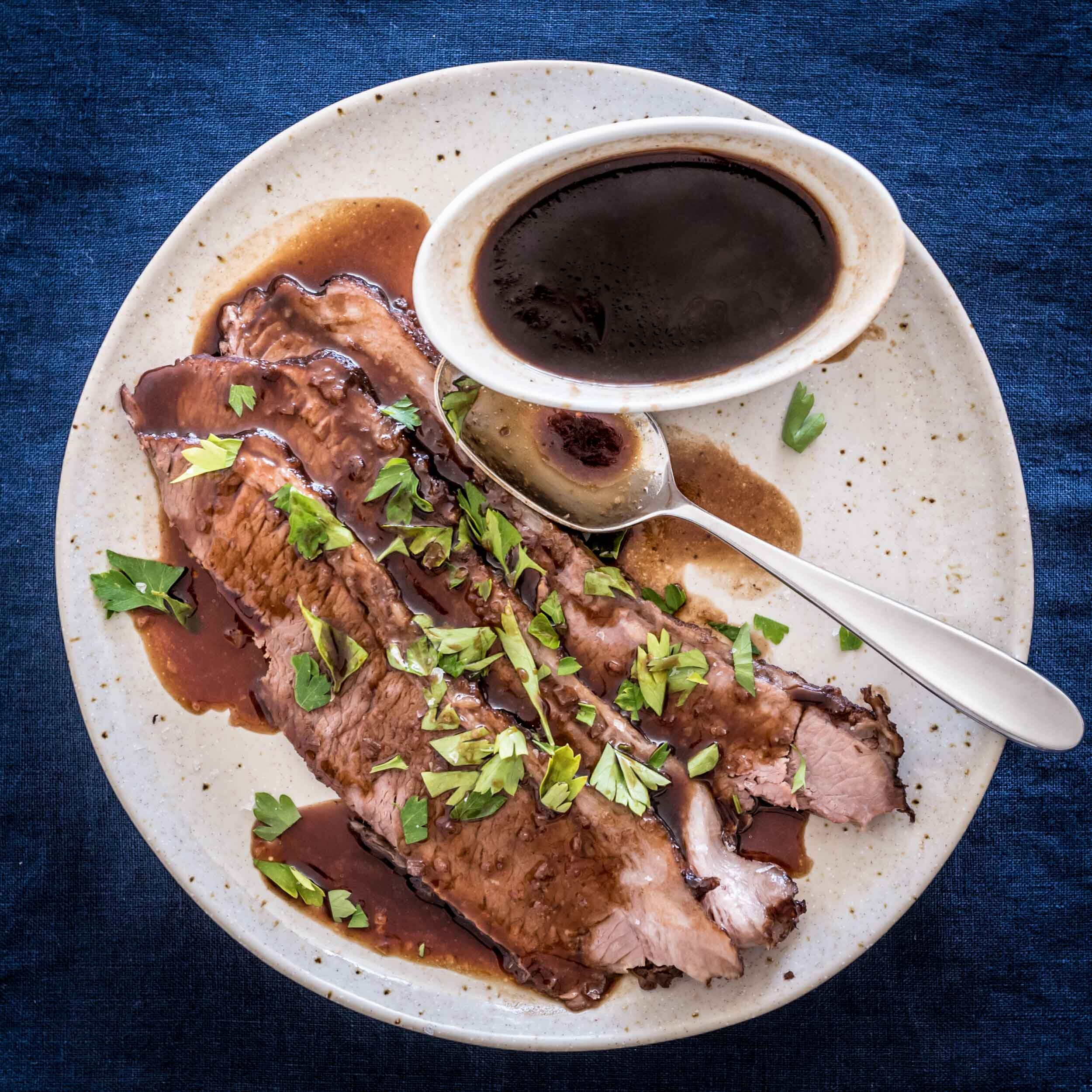
Brisket!
Note: this recipe was part of a book I wrote called Eat Like A Maisel.
Yield: 6–8 servings
You’ve gotta love Midge’s unwavering support of Joel’s comedy career, especially her knack for getting Joel better time slots. Stand-up can be a grind. In the current New York comedy scene, fledgling comedians perform on “bringer shows”—comedians bring paying audience members in exchange for a spot on the show. I perform at a club with a ten-person bringer requirement. When I first started out, I didn’t have ten friends (I still don’t) so I did favors (wink) for the producer.
Even if you don’t do stand-up, the Brisket can grease the wheels on any important thing you need done. Need your car fixed? Brisket. Want a promotion? Brisket. Need your neighbor to do some weird favor involving a snow shovel, some rope, and a petting zoo? Brisket.
This brisket is easy enough to be a weeknight meal but would be equally at home for a special occasion.
1 pound (453 g) carrots, 1⁄2-inch dice
1 pound (453 g) celery, 1⁄2-inch dice
1 pound (453 g) onions, 1⁄2-inch dice
1 brisket, 3–5 pounds, fat and silverskin trimmed (I prefer only a thin strip of fat on top)
Kosher salt, as needed
4 tablespoons (50 g) canola oil
1 750 ml bottle of dry red wine, such as cabernet sauvignon or merlot
32 ounces (1 L) beef stock
Maldon sea salt, as needed
Preheat the oven to 275 ̊F.
For the vegetables
Wash the carrots by running them under cold water and rubbing them with a clean dishrag. The point here is to dislodge any dirt. We’re not going to be eating the carrots in the end, so presentation isn’t as important. Dry the carrots with a fresh dish towel. Remove the root end and cut each carrot into 4-inch-long sticks. Cut lengthwise to halve each segment, then cut lengthwise again to quarter the carrots. Congrats, you’ve just made carrot sticks! We want 1⁄4-inch-thick dice for this preparation, so cut each stick crosswise into 1⁄4-inch-thick slices. You can group three or four sticks together to speed up this process. Set aside in a small bowl.
Remove the root end of the celery by cutting crosswise about 1 to 2 inches up from the root. You want to remove the root and the whitest parts of the celery. Separate the stalks and wash, using your fingers to dislodge any dirt. Dry, cut into 4-inch-long sticks, then cut crosswise into 1⁄2-inch- thick slices. Set aside in a small bowl.
Remove the top (opposite the root end) of each onion. Stand the onion on the cut side and cut in half through the root end. Remove the dry outer layers. With the large cut side down, slice downward every 1⁄4 inch, making sure not to cut all the way through the onion. Hold the onion from the top and make horizontal cuts every 1⁄4 inch. Now, make vertical cuts every 1⁄4 inch down the length of the onion. You’ve just diced an onion! Set aside.
For the brisket
Trim excess fat and silverskin. Salt the entire exterior of the brisket. Grab a few fingers’ worth of kosher salt and sprinkle over the meat from a height of at least 12 inches. Why so high? Because this results in a more even coating of salt. Don’t worry about the amount of salt you’re using here. This may seem like a lot, but remember, that there’s a lot of meat beneath the surface, and a lot of the salt falls off in the cooking process. Repeat for all sides of the brisket.
Heat 3 tablespoons of canola oil in a large pan over high heat. When the oil begins to shimmer, carefully add the brisket—try to avoid splattering everywhere, cussing, and having your spouse roll her eyes at you while suggesting you just order pizza and try to be a man. When the meat is browned on its first side, after about 2 to 4 minutes, flip it to another side. Repeat until all sides are browned, about 12 minutes total. If a side sticks, give it another minute instead of forcing it up. Once complete, remove the brisket from the pan and set aside. Spoon the fat out of the pan. It’s served its purpose, and will only dilute the flavor in the completed dish. Do not wipe the pan clean.
The pan should have brown stuff stuck to the bottom. This is good. This is flavor. We’re going to deglaze the pan, freeing up that yummy brown stuff. The brown stuff is technically called fond. And I’m fond of fond.
Turn the heat to medium, add the wine, and use a wooden spatula to scrape up the brown bits. This is called deglazing. Reduce the wine to a glaze, about 15 minutes. Remove from heat.
Add the brisket back to the pan. Optionally, and to make things easier in the final steps, cut a piece of cheesecloth larger than the pan and cover the meat. Add the onions, carrots, and celery on top of the cheesecloth. Add enough beef stock to cover everything. Gather the cheesecloth and place it inside the pan. Place the pan over high heat and bring the liquid to a simmer. Remember, simmer does not mean a boil. You should see water vapor coming off the top, but it shouldn’t be bubbling. Once it reaches a simmer, cover and place in the oven. Cook for 5 hours, or until the meat is fork tender. If you’re in a rush, you can increase the heat to 325 ̊F and cook for less time, but the meat won’t be as tender.
To complete
Remove the pan from the oven. Gather the edges of the cheesecloth, lift the vegetables out of the pan and reserve to a large bowl. Remove the brisket to a cooling rack to drain for a moment, and then transfer to a cutting board.
Heat the remaining liquid in the Dutch oven over medium high heat and reduce by half to concentrate the flavors. Reserve.
Slice the brisket across the grain into 1⁄4-inch-thick slices. Don’t know where the grain is? Grab a corner of the brisket and pull. You should end up with a long strand of meat. That is the direction of the grain. Cut across that. Arrange the slices on a serving platter. Scatter the reserved vegetables around the meat and drizzle some of the reserved sauce over the whole thing. Top with a few generous pinches of Maldon sea salt.

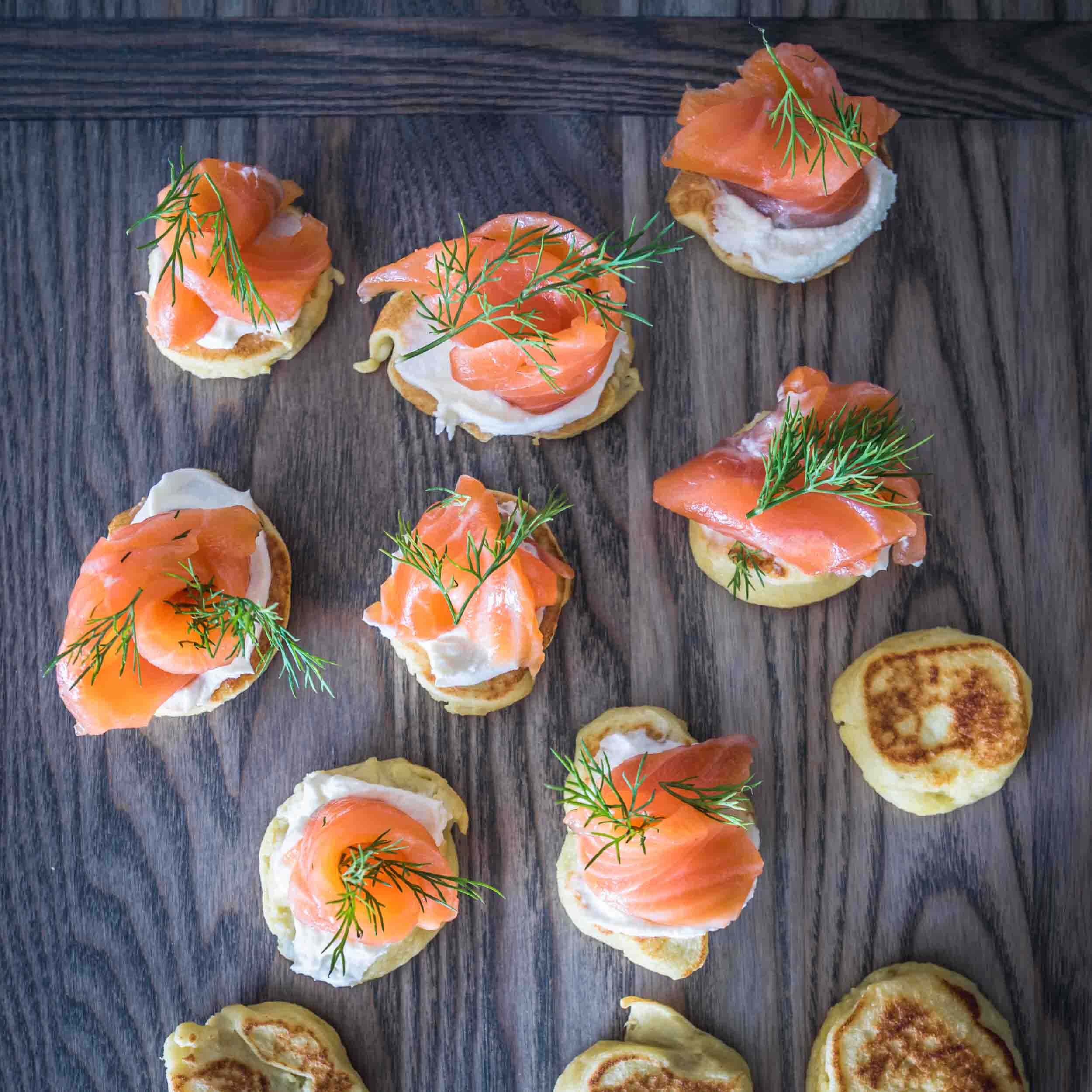
Blini!

Note: this recipe was part of a book I wrote called Eat Like A Maisel.
Yield: 20 blini
I love potato blini. Everything about them. They look cute. Feel cute. Even the name itself is cute.
Blini. It sounds like a sidekick in a Pixar movie, doesn’t it? Make a bunch of them, and they’ll be your little minions. They even kind of look similar.
They’re like little clouds on which you can layer different flavors. But whatever you top it with, make sure it’s flavorful. A common topper is caviar. Tiny, crunchy, salty. Is that what caviar tastes like? I don’t know, I’m not a Russian oligarch.
Here we top it with gravlax and deep-fried capers for a rich and salty crunch combo.
These will taste very plain on their own, severely lacking in salt. If you find yourself cursing my name, just take a deep breath and remind yourself, “These are supposed to be topped with something salty, like gravlax.”
You could easily top these with roasted red peppers for a vegetarian version. Or caramelized onions. Ohh, man, I’m getting hungry again.
1 pound (450 g) Yukon Gold potatoes
4 tablespoons (56 g) butter + more as needed
2 tablespoons (25 g) crème fraîche
2 eggs
2 tablespoons (20 g) flour
Maldon sea salt, as needed
Put potatoes in large pot and cover with at least 1 inch of cold water. Turn the heat to high. Once it comes to a gentle simmer, adjust heat to maintain just a gentle simmer. You don’t want a full boil, as it could damage the outsides of the potatoes. (If the outsides get damaged, the potatoes will begin to absorb water, which means they won’t absorb as much fat later!)
Cook until you can easily pierce the largest potato with a knife, about 30 minutes. It should slide in smoothly. You shouldn’t feel any starchy resistance once they’re fully cooked. If they’re larger, they could take as long as 40 to 50 minutes or longer. Keep that knife handy and, after 20 minutes of simmering, test every 10 minutes.
Drain in a large sieve (or your tamis!) or remove the potatoes from the water with a spider, skimmer, or whatever.
As soon as the potatoes are cool enough to handle, peel them with your fingers. Or, don’t peel them and place them directly on your tamis (more on this in a moment).
Meanwhile, put 4 tablespoons of butter and the crème fraîche into a large mixing bowl.
Put the potatoes through a ricer, food mill, or my favorite, a tamis. You can process the potatoes directly into the bowl. If you feel more comfortable handling the tamis, you can place a sheet of parchment paper directly on your countertop and process the unpeeled potatoes through the tamis right onto that sheet.
If you didn’t process the potatoes directly into the bowl, add them to the bowl with 4 tablespoons of butter and the crème fraîche. Use a wooden spoon and mix to incorporate.
Add the eggs one at a time and stir to incorporate. You’re going for the texture of pancake batter. Add some of the flour to thicken if necessary.
Heat a medium nonstick skillet over medium low heat. Add a small pat of butter to the pan and swirl the pan to coat. Spoon flatware teaspoon-sized dollops of batter into the pan and cook until browned on one side, about 4 minutes. Flip the blini and cook for until browned on the other side.
Serve with gravlax, caviar, or just a small dab of crème fraîche and a pinch of Maldon sea salt.

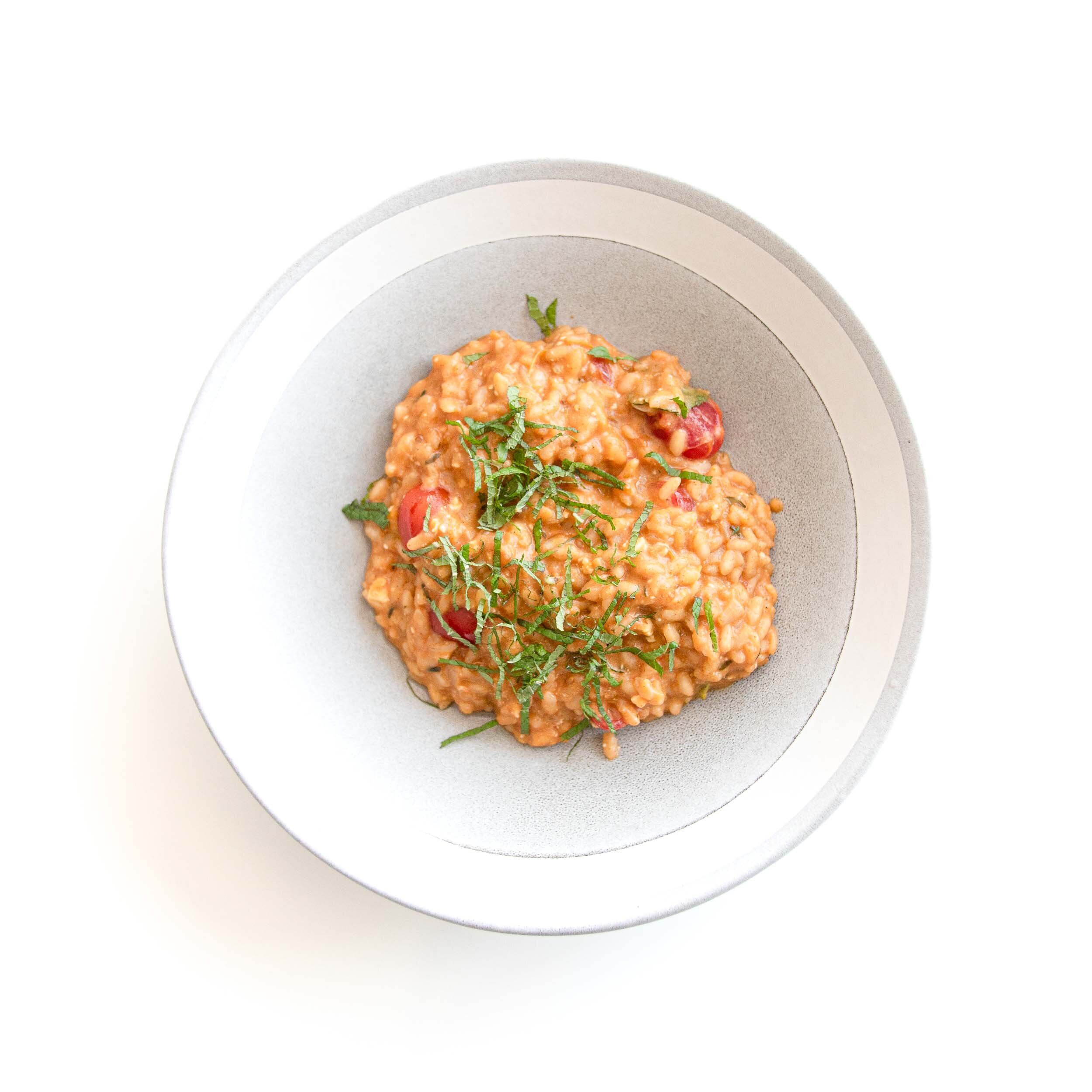
Risotto, tomatoes, feta, paprika

Yield: 2 servings
Risotto isn’t difficult to get right. It’s impossible.
Cook it too fast, and it’s soupy undercooked rice. Too slow? And you’ll never get dinner on the table.
What is it about risotto that makes me want to take a nap midway through?
Try as you might to follow a recipe from a famous chef (like me), it never turns out as easy as they claim or as sexy as the pictures look. Oh, you might get close. You might get 90 percent through the recipe, and think to yourself “I’ve got this!”
You do not got this.
It can be daunting, like doing stand-up right after Lenny Bruce. Here’s my suggestion: take the pressure off yourself. Treat each batch of risotto as a learning experience, have a glass of wine, take a Xanax, relax. You’ll get through it. And you’ll come out a better cook because of it.
32 ounces chicken stock or vegetable stock
4 tablespoons (56 g) butter, divided
2 tablespoons (25 g) olive oil
1 pound (453 g) onions, 1⁄2-inch diced
1⁄2 cup (100 g) Carnaroli risotto
2 teaspoons (8 g) kosher salt
1⁄2 cup (120 g or 120 mL) dry white wine, such as pinot grigio
1 bunch (20 g) thyme, tied with a piece of kitchen twine
1 heaping cup (120 g) cherry tomatoes, halved
2 tablespoons (2 g) thyme
2 teaspoons (6 g) sweet or smoky paprika. Doesn’t matter!
1⁄2 cup (80 g) feta, crumbled
1⁄2 loosely packed cup (3 g) mint
Add chicken stock to a small saucepan, simmer over medium heat.
Add 2 tablespoons butter and olive oil to a large saucepan over medium heat. Add onions to pan and sweat until translucent. Add risotto to the pan and increase heat to medium-high to toast the risotto, stirring continuously to prevent burning. Add the salt and white wine to the pan, stir to incorporate, and cook until the liquid has evaporated.
Add the cherry tomatoes, thyme, and paprika to the pan. Stir to incorporate.
Add 1⁄2 cup of chicken stock to the pan, stir constantly, and cook until the liquid has been fully absorbed. Continue adding stock 1⁄2 cup at a time and stirring until the liquid has been absorbed.
When the risotto is al dente, remove from the heat and stir in the feta, 2 tablespoons butter, and mint. It’s important to stir vigorously at this point. The harder you stir it, the more emulsified the butter and cheese will be. Serve immediately.

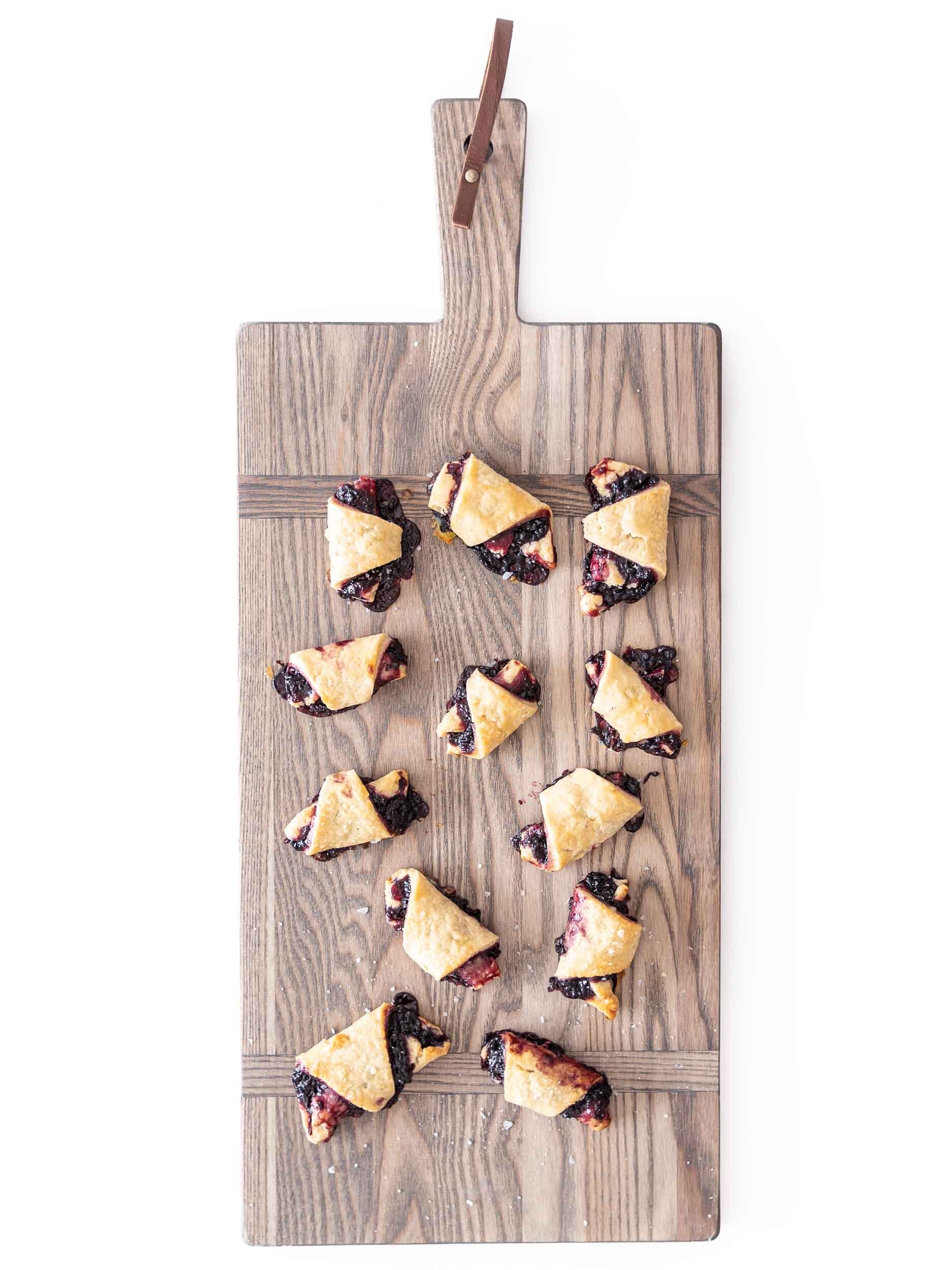
Brown Butter Rugelach
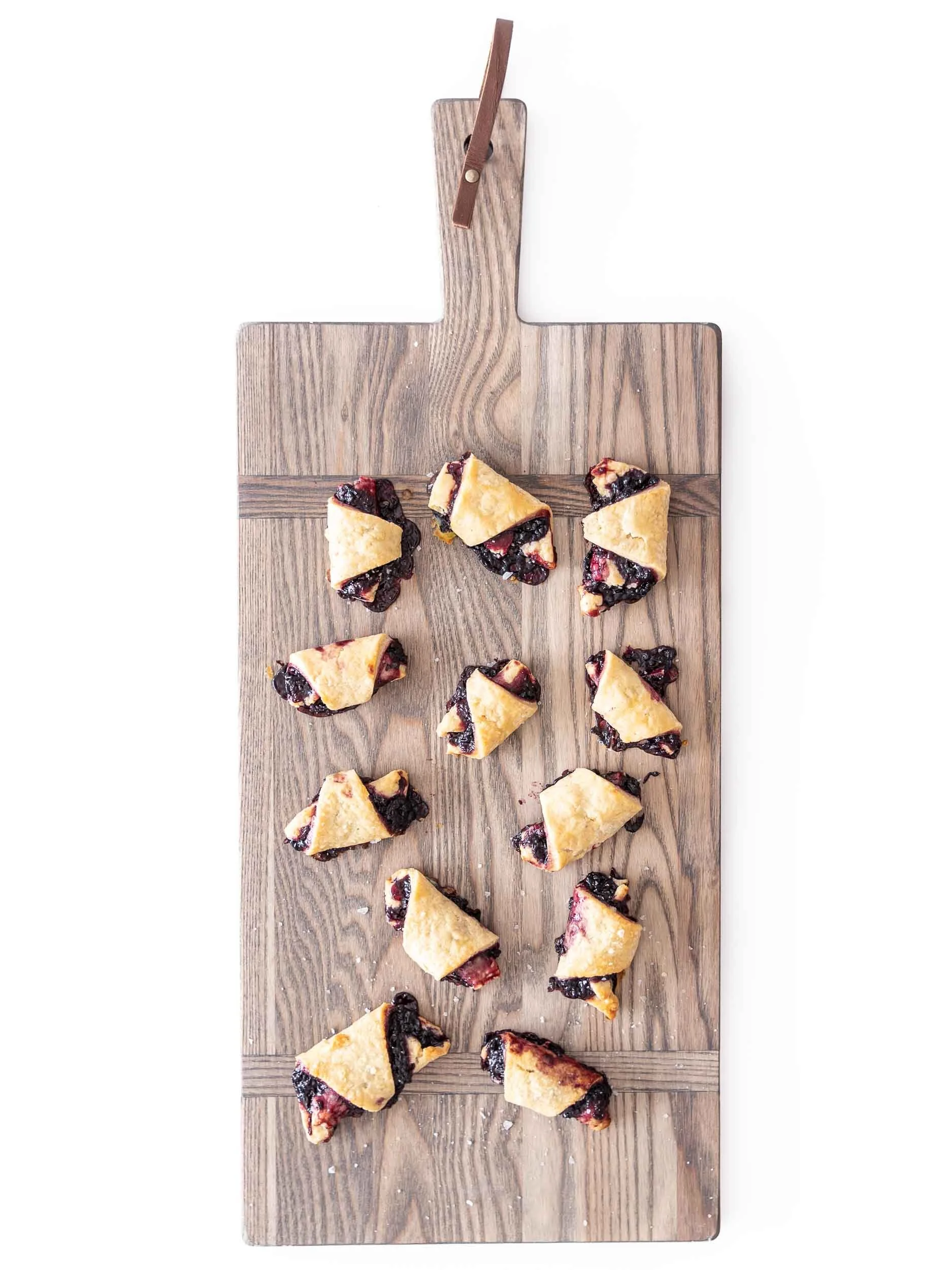
Note: this recipe was part of a book I wrote called Eat Like A Maisel.
How much do I love Herb Smith? Exactly as much as Vern, with every bone in my body.
He’s is one of my favorite cameos. Such confidence, such charisma, and such poor joke-writing skills. Did anyone else want him to tell Midge “never wage a land war in Asia” and “never go against a Sicilian when death is on the line”? I kept waiting for him to laugh hysterically and tip over. That never arrived. But his pickle did! (The pickle’s funny.)
I loved his giant order at the Stage Deli. “A half pastrami on rye, and a half-chopped liver on challah, a stuffed cabbage, some kasha varnishkes, and a bit of arugula.” The first time I watched, I thought his order contained “a bit of rugelach.” When I rewatched it with the captions—after I decided to include this rugelach recipe, and after I wrote, tested, and photographed it—I found out he actually ordered arugula.
So.
Here’s a bit of rugelach for you. I’m sure Herb would’ve appreciated the surprise with his order if the waitress had misheard, too.
Yield: 16 cookies
4 ounces (114 g) butter, divided
4 ounces (114 g) cream cheese
1 cup (150 g) flour
1⁄4 teaspoon (1 g) kosher salt
1⁄2 cup (100 g) jam of your choice (I love blackberry, raspberry, or a combination of the two.)
1 egg (55 g)
Maldon sea salt, as needed
Turbinado sugar, as needed
Add half the butter to a large mixing bowl. Set aside.
Add the remaining butter to a small skillet over medium heat. You don’t need to stir. It will melt, then bubble, then brown. Watch it closely once it starts smelling nutty. It doesn’t take much time to go from brown to burned. Pour it into the bowl containing the rest of the butter. Use a silicone spatula to scrape all the little brown bits into the bowl.
Add the cream cheese to the bowl and stir to mix the ingredients together. You only need to mix enough so that you don’t splatter the liquid everywhere in the next step. (I found this out the hard way . . .)
Use an electric hand mixer to cream the butter and cream cheese in a large bowl. Add the flour and salt and mix on low until incorporated.
Turn out the dough onto a piece of parchment paper and compress it into a ball. Wrap with plastic wrap and refrigerate for at least 2 hours or up to 24 hours.
Line a large baking sheet (or two smaller baking sheets) with parchment paper. Set aside.
Divide the dough in half. Place one half, flat-side down, onto a piece of parchment paper. Cover with another piece of parchment paper and roll into a disc about 9 inches wide. It’s okay if the sides crack while you’re rolling. Depending on how much of a perfectionist you are, you can pull off the cracked parts and press them into other parts of the dough to make it more disc like.
Spoon half the jam onto the disc. Use a paring knife to slice the discs into 8 equal wedges. Roll each wedge in on itself, starting with the wide end and working inward, and place on the parchment paper–lined baking sheet.
Refrigerate for at least 20 minutes. Preheat the oven to 375 ̊F.
Beat the egg in a small bowl. Use a small brush to paint each rugelach with egg. Sprinkle with Maldon sea salt and coarse sugar.
Bake for 15 to 20 minutes, or until the rugelach are golden brown.

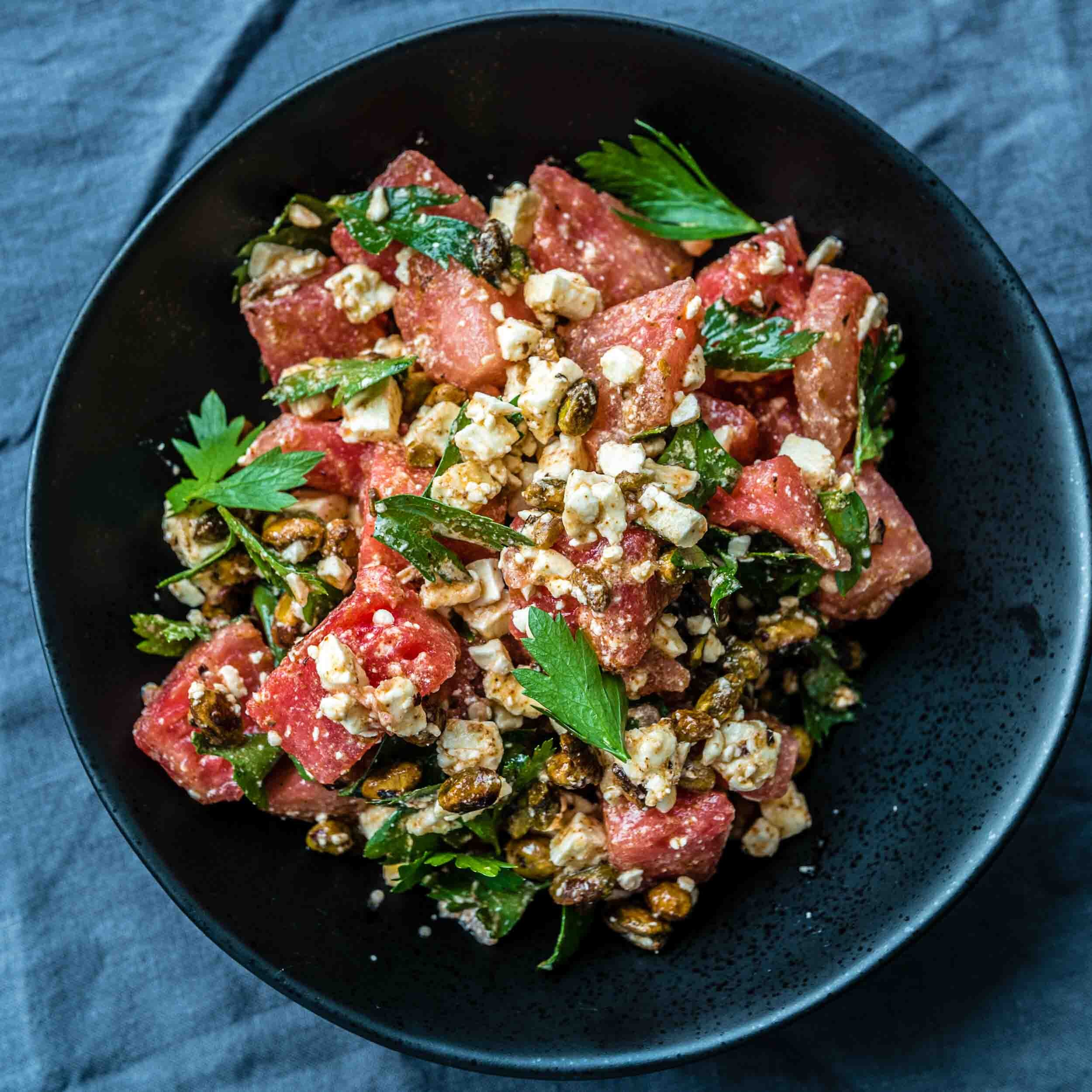
Watermelon salad, feta, mint, EVOO, harissa

Note: this recipe was part of a book I wrote called Eat Like A Maisel.
Yield: 4 servings
How beautiful is this salad! So good. So pink. So salady. But not too salady. Almost no green stuff, save for a few leaves of mint and pistachios, if you can count those. Use the ripest watermelon you can. The melon should feel heavy for its size and should sound hollow.
1 pound (453 g) watermelon, 1-inch cubes
a heaping 1⁄2 cup (100 g) feta cheese
1/3 cup (40 g) pistachios
2 tablespoons (25 g) olive oil
Kosher salt, to taste
1⁄4 cup mint
1 tablespoon harissa powder
8 tablespoons parsley
Add all ingredients to a large bowl and mix to combine. Divide among 4 serving bowls. Garnish with parsley.

Chickpea and Olive Salad
Note: this recipe was part of a book I wrote called Eat Like A Maisel.
Yield: 4 servings
The Weissmans eat salad more than a few times during the first season. Their tastes generally lean toward a simple lettuce salad—which surely has more to do with Zelda’s laziness than the fact that it’s a prop—but I think they’d welcome a change. Should Rose ever ask me for a suggestion, I’d offer this salad. I think it would be as equally welcome on the Weissmans’ table as Ethan is in front of the TV (or as the daughter is to being written out of the script).
3 tablespoons olive oil
2 teaspoons fresh squeezed lemon juice
1 can chickpeas, rinsed
1 cup kalamata olives
1 English cucumber, 1⁄2-inch dice
3 tablespoons red onion, 1⁄4-inch dice
1⁄4 cup flat-leaf parsley
1⁄2 cup feta
Whisk together the olive oil and lemon juice in a large bowl. Add all the ingredients and toss to combine.
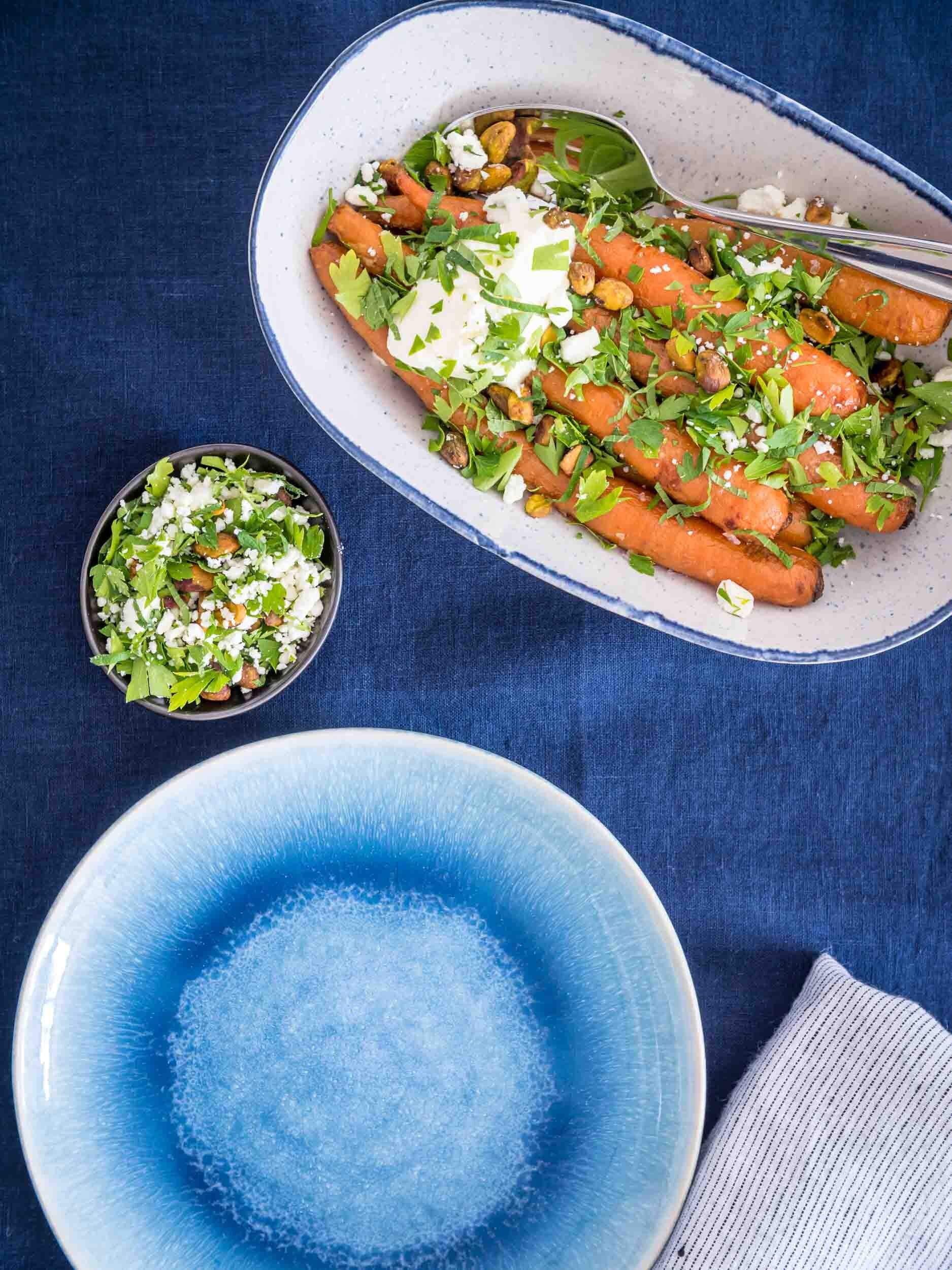
Butter-Roasted Carrots

Note: this recipe was part of a book I wrote called Eat Like A Maisel.
Yield: 4 servings
Maybe Zelda has the night off. Or you’re more focused on a main item, like the Brisket (page 142) or the Rack of Lamb (page 151). Or maybe you just feel like a bunny. Doesn’t matter. This dish is easy, tasty, and the pop of color and textures from the parsley, mint, pistachios, and feta make for a nice surprise.
1 pound (453 g) carrots
1 pound (453 g) butter
4 tablespoons (5 g) parsley
8 tablespoons (2.5 g) mint
1⁄4 cup (40 g) feta
1⁄4 cup (30 g) pistachios
Kosher salt, to taste
4 garlic cloves, optional
1 bunch (20 g) thyme, tied with a piece of kitchen twine, optional
Wash the carrots, scrubbing vigorously. Wrap a clean dishrag around the carrot and push and pull the carrot through it. Seriously. You’re going to be uncomfortable. You’re going to make anyone watching you uncomfortable. But when you’re done, the carrots should have a soft, velvety skin. Which I think makes this whole exercise even more awkward.
Melt butter in a large sauté pan. You want a pan small enough to fit the carrots, but not so large that you have tons of extra room. I used a 12-inch cast iron skillet. You can chop them into shorter lengths if you wish, but I prefer the presentation of full-length carrots.
Add the carrots to the pan. Careful! Don’t splash any of that butter. This is the time to add the optional garlic and thyme.
Preheat the oven to 300 ̊F.
Carefully move the carrots to the oven and roast for 2 hours. If the carrots aren’t completely covered in butter, rotate or baste them occasionally so they don’t dry out.
Remove from oven. Transfer the carrots to a cooling rack on an aluminum foil–lined baking sheet. Transfer the butter in the pan to a jar. Congrats, you just made carrot-flavored ghee! Use this as you would butter, keeping in mind that it’ll have a subtly sweet flavor.
Toss the carrots with parsley, mint, pistachios, feta, and salt (to taste) and serve.

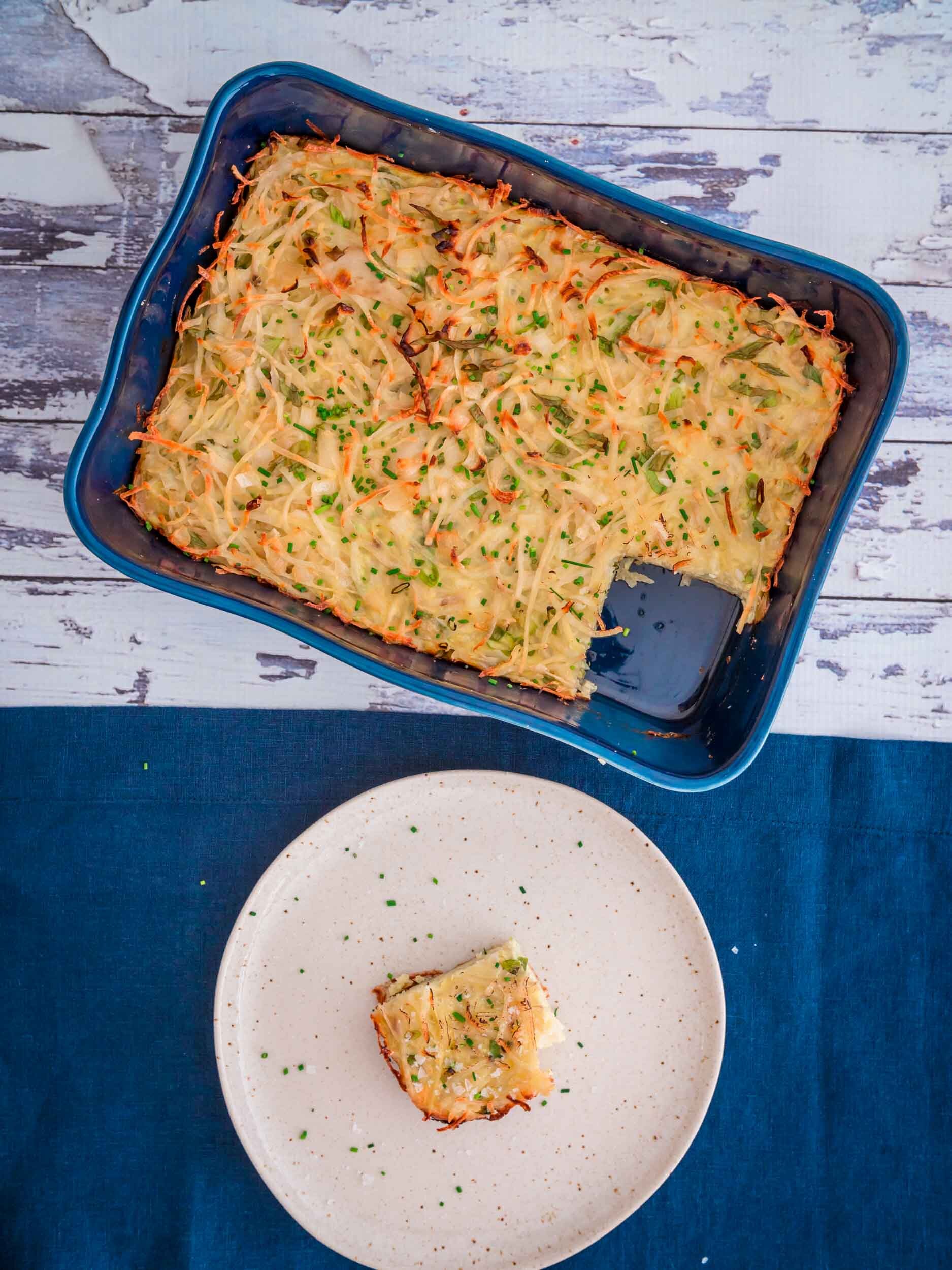
Potato Kugel
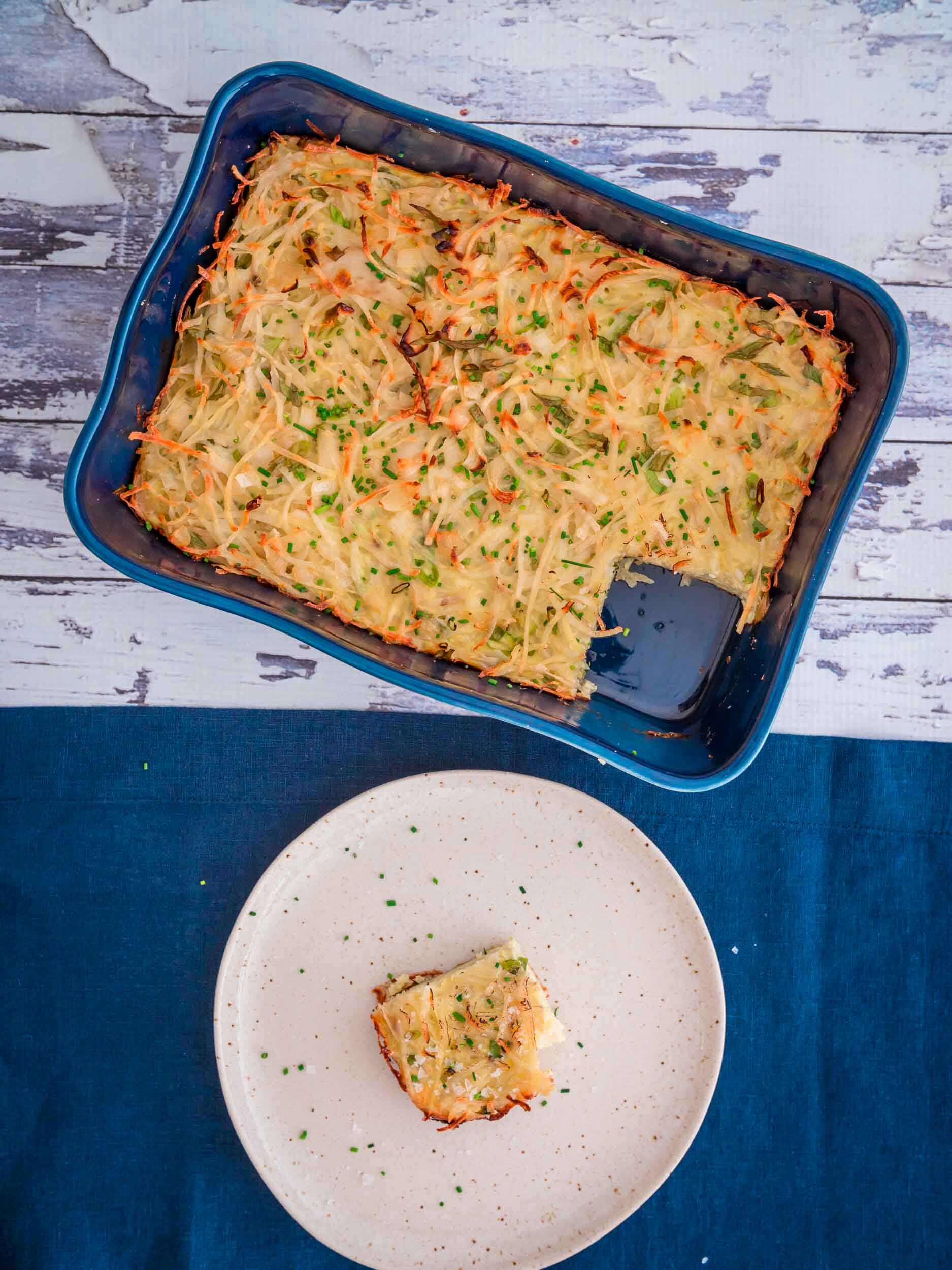
Yield: 4-8 servings
The kugel, to me (a gentile), is the epitome of Jewish comfort food. It makes me wish I’d had a bubbe to make this for me. Both the Weissman and Maisel households would have a kugel on rotation. And for good reason. It’s easy to prepare, it’s so flavorful, and it can feed a large group.
2 pounds (900 g) russet potatoes, grated
1⁄4 cup (35 g) flour
2 tablespoons (25 g) canola oil
1 pound (453 g) onions, 1⁄2-inch dice
1 cup (30 g or 1 ounce) green onion, chopped
3 whole eggs
3 egg yolks
2 teaspoons (8 g) kosher salt
1⁄2 cup (100 g) crème fraîche
Chives, for garnish
For the potatoes
Fill a large bowl with cold water and set next to your work area. Grate the potatoes using a food processor fitted with the grater attachment or a coarse grater and add to the bowl of water. This will help remove some of the starch, which will help make the kugel lighter. Dry them in a salad spinner or by laying them out on a clean dishcloth. Toss with 1⁄4 cup flour.
For the onions
Heat the oil in a medium skillet over medium heat and add onions. Sweat until translucent, about 10 minutes. Remove to a bowl.
For the custard
Add the 3 whole eggs, the 3 yolks, the salt, and the crème fraîche to a large bowl and mix together.
To complete
Preheat oven to 400°F. Add onions and potatoes to the custard and mix together. Lightly oil a 7 x 9–inch casserole dish with 1 to 2 tablespoons canola oil. Add the potato custard. Bake in a 400 ̊F oven for 45 to 60 minutes or until the top is golden brown and the custard no longer wobbles when you jiggle the dish. Garnish with thinly sliced chives.


Latkes

Note: this recipe was part of a book I wrote called Eat Like A Maisel.
Yield: 4–6 latkes
Baz: “Next time, I’d like some latkes.”
Midge: “I make great latkes. Genius latkes. You won’t be sorry!”
Oh, Baz. He knows he’s in a great position. As long as he gives Joel a terrible time, he can get free brisket. And, while he’s got a pink Pyrex full of beautiful brisket, he’s got the chutzpah to ask for latkes next time. You gotta hand it to him. He knows what he’s doing. At least when it comes to negotiating for food.
You have a few options for cooking this recipe. Instead of creating one giant latke and cutting it after cooking, you could create smaller individual latkes and flip them using a spatula. Or you could use a smaller pan and just make smaller latkes.
They are light and fluffy and crunchy, the holy trinity of potato perfection. Which is a bit confusing in a traditionally Jewish dish.
1 pound (453 g) russet potatoes
1 bunch, (4 to 6) green onions
6 tablespoons (80 g) canola oil
Peel and coarsely grate potatoes. If you have a food processor, use the grater attachment to quickly grate all the potatoes. If not, use a box grater and prepare to get a workout.
Immediately put the grated potatoes in a bowl and fill with water. Soak for 10 minutes.
Meanwhile, remove the root and white parts of the green onions and discard. Cut off the darkest green parts—usually the top 3 to 6 inches—of two of the onions and set aside. Make one cut down the length of the green onion tubes, taking care not to split the entire onion into two separate halves. You’re just opening up the tube. Then, slice crosswise into 1/8-inch-thick slices.
Set aside. We’ll use those for a garnish. You can keep the greens in a little tub of water and stick them in the fridge if you’re not going to use them for a few hours. It’ll keep them nice and crisp.
Slice the rest of the green onions crosswise into 1/8-inch-thick slices. It’s okay to mix the light green and dark green parts together for this. Set aside.
Dry the grated potatoes in a salad spinner. If you don’t have a salad spinner, drain them in a large sieve, and then dry on a paper towel–lined baking sheet.
Heat 1/8 inch of canola oil in a large nonstick sauté pan over high heat. When it starts to shimmer, reduce heat to medium and carefully add a third of the potatoes. Don’t splash the hot oil everywhere. Sprinkle them in like you’re a fairy blessing someone with potatoes.
Sprinkle half of the green onions on top of the potatoes. Repeat with another third of the potatoes, and the rest of the green onions. Sprinkle the remaining potatoes on top.
Cook for 5 to 8 minutes, or until well browned. Use a fish turner or offset spatula to flip the giant latke. Don’t hurt yourself. Cook for another 5 to 8 minutes, or until the other side is browned.
Slide the giant latke onto a paper towel–lined plate. Cut into quarters and serve immediately, topped with the reserved sliced dark green onion. If you reserved them in water, be sure to drain them before using.
The Art of Latke Flipping
There’s no high quite like killing it on stage. (I could be wrong . . . I’ve never done drugs.) But flipping a giant latke comes close.
The hardest part of flipping latke is the mental preparation. It’s mandatory that you stress out. It’s important that you work yourself into a mental tizzy visualizing the flip. The wrist pop, the midair flip. The oil splattering all over your new Theory shirt or dress. The dog barking in anticipation that, as usual, the latke turning end over end in the air will land on the floor.
But then you stick the landing. The latke falls magically into the pan as if it never left in the first place. The crowd cheers.
You don’t have a crowd? You should totally get yourself a crowd.

Cauliflower "rice", guanciale, pesto

Note: this recipe was part of a book I wrote called Eat Like A Maisel.
Yield: 2–4 servings
Cauliflower smells like farts. There’s no way around it. Hopefully the Weissmans knew this as Zelda prepared the pureed cauliflower for the failed Mordecai Glickman dinner (spoiler alert: Mordecai’s dead). Otherwise they assumed the worst of her. Once you cook it, it smells great. But, if you’re like me and like to prep your ingredients ahead of time, know that your fridge may smell like toots until you cook it.
I don’t know whether the Weissmans kept kosher all year. For the sake of this recipe, let’s assume that they didn’t. Rose seeks the advice of a psychic, for goodness sake. If it’s difficult for you to picture Rose eating pork, then just imagine this at empty-headed Penny’s place.
Bottom line: I don’t care who in the Maisel world cooks this—it could be the woman ordering pork in the butcher shop or the doormen for all I care!—as long as someone cooks it. (Can you tell I’m a fan of guanciale?)
4 ounces (100 g) guanciale, cut into lardons 1⁄4-inch by 1⁄4-inch by 1-inch
1⁄2 head (600 g) cauliflower, stem removed
1⁄2 teaspoon (2 g) kosher salt
1⁄2 cup (100 g) pesto (recipe follows)
Add the guanciale to a medium skillet set over high heat. Once the guanciale starts to sizzle, reduce heat to low. Cook until the guanciale is crispy, about 20 minutes. Flip each lardon once about halfway through to crisp the other side. You don’t need to stir, toss, or shake the guanciale. Just enjoy your glass of wine.
Remove all but 1 tablespoon of the fat from the pan. (You don’t need to measure; just estimate.) Tip the pan to pool the fat on one side and spoon it into a jar or metal bowl. You can save it for a flavorful finishing fat. Or discard.
Use a food processor with the grater attachment and grate the cauliflower. Add the cauliflower to the pan and turn the heat up to medium-high. Add kosher salt. Cook for 8 to 10 minutes, until the cauliflower is browned and cooked through. Similar to browning the guanciale, you don’t need to stir frequently. The cauliflower is so small that it doesn’t take much to cook out the raw flavor. We’re focusing our efforts on browning the cauliflower. So, after you add the cauliflower, let it sizzle for a few minutes. Use your nose. If you smell it getting browned and almost burned, stir it. This is a great recipe to develop your cooking intuition because the cauliflower is so forgiving.
Remove from the heat and stir in pesto. The residual heat in the pan will heat the pesto. After mixing, taste it and add more salt as necessary.
Serve as a side to a main dish for 4 people, or on its own for 2 people.
Pesto
Yield: about 2 cups
8 ounces (225 g) basil leaves
8 garlic cloves (40 g)
2 cups (250 g) pine nuts
2 cups (100 g) grated Parmigiano-Reggiano cheese
1 1/3 cups (300 g) olive oil
Process the basil, garlic, and pine nuts into a paste in a food processor. Add the cheese and process to mix. With the processor running, add the olive oil in a slow stream until completely mixed. Transfer to a sealable container and top with a layer of olive oil if not using immediately.

Pan-Seared Roughy, lemon, mint, chive butter

Note: this recipe was part of a book I wrote called Eat Like A Maisel.
Yield: 2 servings
We don’t see much fish in the Marvelous Mrs. Maisel world. Which is a shame. Fish are funny. Especially the clown fish! (Though they’re too slapstick for me...) Astrid is surprised her gefilte fish gift goes missing, and Susie’s happy as a clam (which she ate, by the way) to get her claws on some lobster. I hope she figured out how to hide it under her hat.
This is a great one to keep in your tackle box of recipes. It’s quick and easy enough for a school night, but light and elegant enough for a date night. (I never want heavy foods for date night.) Throw some Blistered Green Beans or Roasted Asparagus on the plate for an easy side.
If you can’t find orange roughy, you’re not exactly off the hook. I’d recommend staying away from swordfish and other meatier fishes for this preparation, but you can use whatever type of fish looks freshest. Ask your fishmonger. Use your nose.
Speaking of which... The seafood counter should smell like seafood, which means it should not smell at all. My rule: if it smells like fish, cut bait and run.
2 (8-ounces, 225 g total) fish fillets
Kosher salt
4 tablespoons (56 g) butter
1⁄2 cup (20 g) green onions, 1⁄4-inch slice
4 tablespoons (4 g) mint
2 tablespoons (2 g) chive
4 tablespoons (30 g) nonpareil capers
2 tablespoons fresh squeezed lemon juice
Pat the fish dry with paper towels and sprinkle with kosher salt.
Add the butter to a medium nonstick skillet over medium heat. When the butter starts to bubble, add the fish.
Sprinkle the green onions over the fish and, tilting the pan, use a spoon to baste the fish for 5 minutes. Use a fish turner to turn the fish.
Add the mint, chives, and capers to the pan and continue basting for 2 minutes. Use the fish turner to move the fish to a paper towel–lined plate.
Divide the fish between two plates and top with the mint, chive, and butter from the pan. Drizzle the fresh-squeezed lemon juice over the fish.
For an optional, fancy-looking garnish, use green onion strips. To do so, slice down the length of the green onion, then slice on a severe bias.

The Gin & Tonic

Note: this recipe was part of a book I wrote called Eat Like A Maisel.
Ah, the G and T. The quintessential summer sipper.
I highly recommend using good-quality gin and tonic. For gin, I love the citrus, spice, and Italian juniper The Walter Collective uses. Malfy also makes a fun gin. But use whatever you’ve got. As I always say, the best gin is whichever gin’s in your hand. For tonic, Fever Tree makes an excellent option. It’s more expensive than the large plastic bottles of tonic, but remember: better, not more.
1 lemon, sliced into 1⁄4-inch-thick wheels
21⁄4 ounces (70 mL) good gin
4 ounces (120 mL) good-quality tonic
Heat a small skillet or grill pan over medium-high heat. Once it’s hot, place the lemon wheels in the pan and brown. Flip once to brown the other side. Set aside.
Fill a double old-fashioned glass with ice. Add gin. Pour in tonic. Give it a gentle stir. Garnish with a sprig of rosemary and the reserved lemon wheel.
For bonus points, after you add the gin, put a barspoon into the glass and pour the tonic down the spoon. It’s a fun party trick, and you can taste the extra playfulness.

Chocolate Pudding
This light, airy chocolate pudding comes together in no time at all. If you use a darker chocolate than the 60% called for, feel free to add a few tablespoons of sugar to compensate for the increased bitterness.
Serves 2
4.5 ounces (125 g) 60% dark chocolate
1⁄2 cup (110 g) heavy cream
4 (140 g) egg whites
Use a chef’s knife to chop the chocolate. Add it to a bowl and set aside.
Bring the cream to a simmer over medium-high heat. Once it simmers, pour over the chocolate and whisk to combine. Set aside to cool.
In a separate bowl, use an electric hand mixer to beat the egg whites to stiff peaks. If you’re new to the baking world, turn the mixer over so the paddle attachments point up. Does the egg white on the paddles keep its peaks? If not, continue beating.
Fold the beaten egg whites into the chocolate mixture one-third at a time. To fold: use a spatula to pull one-third of the egg whites into the bowl containing the chocolate, insert the spatula into the center of the bowl, and fold in the egg whites. Turn the bowl 90 degrees and repeat. Once incorporated, repeat with the remaining egg whites. The goal here is to gently mix without deflating the egg whites.
Top with extra Harissa-Candied Almonds, or a generous pinch of Maldon sea salt.

Gravlax

Note: this recipe was part of a book I wrote called Eat Like A Maisel.
These days I love lox. Any lox. Gravlax. Belly lox. Even Goldilocks.
But I grew up hating it.
The Pacific Northwest, where I’m from, has 482 kinds of salmon. We have Coho salmon, Chinook salmon, and King salmon. We even have Copper River salmon, which is only in season for two days every third spring and retails for $800 per pound.
But we’re taught to hate any salmon east of the Cascades. My parents raised me to hate Atlantic salmon. And their parents raised them to hate it. (My grandparents learned to hate it from the Native Americans.)
But then I moved to New York and put my prejudices aside. I tried Atlantic salmon. And it was delicious.
To my West Coast family and friends: give Atlantic salmon a try. I think you’ll be surprised. Put this on a bialy, blini, or bagel. (Anything that begins with a b.)
Gravlax Recipe
4 tablespoons + 1⁄2 teaspoon (50 g) kosher salt
3 tablespoons (40 g) sugar
1⁄2 cup (20 g) fresh dill, chopped
1 ounce London dry gin, such as Bombay Sapphire (optional, but recommended)
1 pound (453 g) center-cut salmon fillet, pinbones removed
Mix salt, sugar, dill, and gin in a bowl and set aside.
Cut a piece of plastic wrap about one-and-a-half times longer than the fillet and place it on your work surface. Place the salmon on plastic wrap, skin-side down. Sprinkle the salt mixture over the salmon, pressing it into the flesh. Wrap the fish in the plastic wrap and place it on a small baking sheet.
Place another baking sheet on top of the fish and weigh it down with whatever you have handy—a few cans of beans, that jar of gefilte fish from Astrid, or the giant mezuzahs, also from Astrid.
Refrigerate for 24 hours.
Rinse off salt and sugar and pat dry with paper towels. If you prefer a firmer texture, refrigerate uncovered it for 12 to 24 hours.
To serve, slice thinly with a sharp knife and serve with bagels and schmear or some rye bread.

Sautéed Duck Breast with Watercress Salad

If pork is the other white meat, duck is the other red meat. And it has something red meat can never touch: crispy skin.
It has the crispy skin of chicken and meatiness of red meat. It’s the Frankenstein of the meat world! Some may cry fowl at my reference [and my poultry puns], but I didn’t want to write the word “monster,” as in “Frankenstein’s monster,” in a cookbook. [Now look what you made me do.]
A note on the serving size: duck breasts are around eight ounces apiece, which makes them large enough to split for a lighter meal, as my wife and I often do. If I’m still hungry (or even if I’m not), I’ll have some extra Crème Fraîche Cheesecake or Chocolate Almond Cake.
2 duck breasts, roughly 8 ounces each
Kosher salt, as needed
1 tablespoon (10 g) olive oil
1 teaspoon (20 g) lemon juice
3 cups (100 g) watercress
Score the fat on the duck breast. Use a sharp knife and slice the fat every 1⁄2 inch. Be careful not to cut into the flesh. We’re just scoring the fat so it renders better. Salt both sides of the duck.
Set a medium skillet over medium heat. Lay the duck breasts in the pan skin-side down and lower the heat to medium-low. Tilt the pan and spoon the fat out as it renders. I recommend saving this fat. I use it for sautéing spinach for breakfast. It’s delightfully flavorful.
Cook for 16 to 18 minutes. If the skin browns too quickly, reduce the heat to low. Flip the breasts over and cook for 1 to 2 minutes more.
If you prefer the precision of a thermometer—and there is no shame in that!—insert a probe thermometer and stop cooking when it reaches 135 ̊F (58 ̊F). Make sure to insert through the end of the breast to ensure you take the temperature of the center of the meat, not the edge.
For the salad
Whisk together oil, vinegar, and salt in the base of a large bowl. Cut the watercress into 2- to 3-inch-long pieces and add to the bowl. Toss to combine. There is not much dressing here, and that’s on purpose. I like watercress with little to no dressing, but feel free to add more if you wish.
To complete
Slice the duck breast into 3⁄4-inch-wide pieces. You could go across the breast, as I’ve done in this photo, or you could go lengthwise for a more dramatic preparation. Serve with dressed watercress.